














 American Made Advocacy: American PCBs in Big Demand and Short Supply
 Defense Speak Interpreted: Will Defense Become a Totally New Supplier for Drone Electronics?
 The Right Approach: The End of an Era—DoD Proposes MIL-PRF-31032 Cancellation





There are more than 3,900 confirmed planets beyond our solar system. Most of them have been detected because of their “transits” — instances when a planet crosses its star, momentarily blocking its light. These dips in starlight can tell astronomers a bit about a planet’s size and its distance from its star.
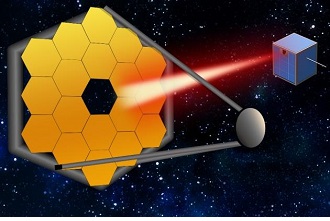
Image Caption: In the coming decades, massive segmented space telescopes may be launched to peer even closer in on far-out exoplanets and their atmospheres. To keep these mega-scopes stable, MIT researchers say that small satellites can follow along, and act as “guide stars,” by pointing a laser back at a telescope to calibrate the system, to produce better, more accurate images of distant worlds. Christine Daniloff, MIT
But knowing more about the planet, including whether it harbors oxygen, water, and other signs of life, requires far more powerful tools. Ideally, these would be much bigger telescopes in space, with light-gathering mirrors as wide as those of the largest ground observatories. NASA engineers are now developing designs for such next-generation space telescopes, including “segmented” telescopes with multiple small mirrors that could be assembled or unfurled to form one very large telescope once launched into space.
NASA’s upcoming James Webb Space Telescope is an example of a segmented primary mirror, with a diameter of 6.5 meters and 18 hexagonal segments. Next-generation space telescopes are expected to be as large as 15 meters, with over 100 mirror segments.
One challenge for segmented space telescopes is how to keep the mirror segments stable and pointing collectively toward an exoplanetary system. Such telescopes would be equipped with coronagraphs — instruments that are sensitive enough to discern between the light given off by a star and the considerably weaker light emitted by an orbiting planet. But the slightest shift in any of the telescope’s parts could throw off a coronagraph’s measurements and disrupt measurements of oxygen, water, or other planetary features.
Now MIT engineers propose that a second, shoebox-sized spacecraft equipped with a simple laser could fly at a distance from the large space telescope and act as a “guide star,” providing a steady, bright light near the target system that the telescope could use as a reference point in space to keep itself stable.
In a paper published today in the Astronomical Journal, the researchers show that the design of such a laser guide star would be feasible with today’s existing technology. The researchers say that using the laser light from the second spacecraft to stabilize the system relaxes the demand for precision in a large segmented telescope, saving time and money, and allowing for more flexible telescope designs.
“This paper suggests that in the future, we might be able to build a telescope that’s a little floppier, a little less intrinsically stable, but could use a bright source as a reference to maintain its stability,” says Ewan Douglas, a postdoc in MIT’s Department of Aeronautics and Astronautics and a lead author on the paper.
The paper also includes Kerri Cahoy, associate professor of aeronautics and astronautics at MIT, along with graduate students James Clark and Weston Marlow at MIT, and Jared Males, Olivier Guyon, and Jennifer Lumbres from the University of Arizona.
In the Crosshairs
For over a century, astronomers have been using actual stars as “guides” to stabilize ground-based telescopes.
“If imperfections in the telescope motor or gears were causing your telescope to track slightly faster or slower, you could watch your guide star on a crosshairs by eye, and slowly keep it centered while you took a long exposure,” Douglas says.
In the 1990s, scientists started using lasers on the ground as artificial guide stars by exciting sodium in the upper atmosphere, pointing the lasers into the sky to create a point of light some 40 miles from the ground. Astronomers could then stabilize a telescope using this light source, which could be generated anywhere the astronomer wanted to point the telescope.
“Now we’re extending that idea, but rather than pointing a laser from the ground into space, we’re shining it from space, onto a telescope in space,” Douglas says. Ground telescopes need guide stars to counter atmospheric effects, but space telescopes for exoplanet imaging have to counter minute changes in the system temperature and any disturbances due to motion.
The space-based laser guide star idea arose out of a project that was funded by NASA. The agency has been considering designs for large, segmented telescopes in space and tasked the researchers with finding ways of bringing down the cost of the massive observatories.
“The reason this is pertinent now is that NASA has to decide in the next couple years whether these large space telescopes will be our priority in the next few decades,” Douglas says. “That decision-making is happening now, just like the decision-making for the Hubble Space Telescope happened in the 1960s, but it didn’t launch until the 1990s."
Page 1 of 2


