

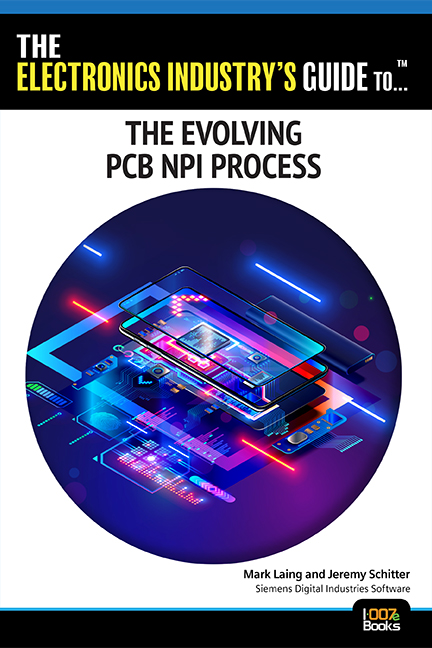
In this book, the authors look at how market changes in the past 15 years, plus the slowdown of production and delivery of materials and components in recent years, have affected the process for new product introduction (NPI) in the global marketplace. As a result, we feel that PCB production companies need to adapt and take a new direction to navigate and thrive in an uncertain and rapidly evolving future.
We'll look at how the NPI process can be streamlined by using a digital twin of the product design that can be transferred more easily and quickly, with greater collaboration and transparency, through manufacturing and ultimately to delivery to the customer. We also address new solutions that can help to better manage supply.
Mark Laing
 Mark graduated with a B.Sc. in Electrical and Electronic Engineering from Loughborough University in the UK. He has over 25 years’ experience in PCB manufacturing with particular strengths in test and inspection methodologies with three test companies, namely Marconi Instruments in the UK, followed by GenRad and Teradyne in the US. He then moved more into software solutions for Router Solutions Incorporated, who were acquired by Mentor Graphics Corporation in 2006. When Mentor acquired Valor Computerized Systems in 2010, Mark moved to that division, where he has been working as both a product marketing manager and business development manager. Mark has been granted three patents, one in the UK and two in the US, and has recently filed for a fourth. With the acquisition of Mentor by Siemens Digital Industries Software, Mark is looking forward to furthering his career with Siemens. Mark has lived in the US for over 20 years, and now resides in Erie, Colorado, with his wife and two sons.
Jeremy Schitter
 Jeremy joined Mentor Graphics as a senior application engineer in March 2010 through the acquisition of Valor. Before that he worked for Valor for more than 3 years holding several pre-sales and engineering positions. Jeremy played a key role in realizing growth for Valor for the emerging Valor Process Preparation solution and was involved as a presales application engineer in most MES Projects in EMEA.
Since 2014, Jeremy has been part of the global Valor business development team, supporting the worldwide business for the process engineering solution of the Valor product portfolio: Valor Process Preparation, Valor Parts Library, Opcenter Scheduling SMT, Valor BOM Connector and the emerging cloud-based solution Valor PCBFlow.
Prior to Valor, Jeremy worked 11 years for a Siemens electronic manufacturing site in Germany as NPI engineer and SMT production manager.
Siemens Digital Industries Software is driving transformation to enable a digital enterprise where engineering, manufacturing, and electronics design meet tomorrow. Our solutions help companies of all sizes create and leverage digital twins that provide organizations with new insights, opportunities, and levels of automation to drive innovation. For more information on Siemens Digital Industries Software products and services, visit siemens.com/software or follow us on LinkedIn, Twitter, Facebook and Instagram. Siemens Digital Industries Software – Where today meets tomorrow.
Engineering Manager, Digital Transformation and IIoT Solutions Architect, SRXGlobal Nick Niculita
Nick Niculita currently serves as engineering manager at SRXGlobal Melbourne, where he leads the prototype, production/NPI, process, maintenance and test engineering teams. His responsibilities include overseeing the engineering department and also leading the digital transformation and IIoT [...]
General Manager, ESCATEC Penang Carolus Lambertus Schutters
Lambert Schutters has been in the electronics industry for over 33 years. He is the general manager of ESCATEC Electronics, ESCATEC Medical, and ESCATEC Technology (collectively known as ESCATEC Penang), which are based in the global electronics cluster of Bayan Lepas in Penang, Malaysia. Lambert [...]
Chapter Summaries
-
Chapter 1
How the NPI Process has Changed and Where We’re Going
A brief history and the future of NPI.
-
Chapter 2
Managing the BOM Handoff More Efficiently, Especially During Supply Chain Shortages
A look at mBOM files created by the OEM. Quality and consistency of data is critical for successful outcome.
-
Chapter 3
Streamlining Data Preparation
Data preparation forms the basis for typical NPI flow. Accurately importing source layout CAD data is an important first step.
-
Chapter 4
Optimizing Stencil Design and the Inspection Phase
This chapter focuses on automation methodologies to improve efficiency of NPI.
-
Chapter 5
Decreasing Electrical Test Debugging and Machine Prep Time
A discussion of utilization of electrical test to improve NPI process efficiency.
-
Chapter 6
Data Portability, or How to Efficiently Make the Same Product in Multiple Locations
Using the digital twin model to achieve full product portability.
-
Chapter 7
Future-proofing NPI With a Holistic Digitalized Process
Discussion of how the knowledge gained from digitalization of the manufacturing process is harnessed as continuous improvement upstream.
Print-on-demand paperbacks are available for this title. Click below to order from our distributor.
What Our Readers Are Saying
This book is a must-read for everybody who wants to improve the overall design-through-manufacturing NPI phase and ultimately do more with less, the Holy Grail of any manufacturer.
Nick Niculita, Engineering Manager, SRXGlobal
We need the right tools to create the best design for the intended purpose. This book is a great introduction and guide on how to approach the process holistically.
Lambert Schutters, General Manager, ESCATEC Penang