

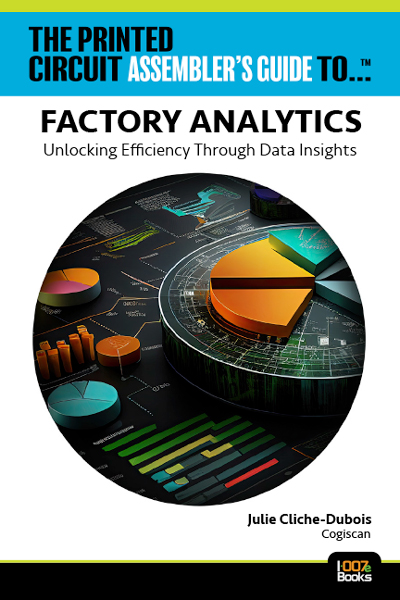
Using and understanding factory analytics is the future for electronics manufacturers. Those who strategically prioritize analytics and properly leverage the insights generated throughout their entire operation systematically will stand the test of time. In this fast-changing, deeply competitive, and margin-tight industry, factory analytics can be the key to unlocking untapped improvements to guarantee a thriving business.
ISBN: 978-1-959894-08-7
ISBN: 978-1-959894-12-4 Print-on-demand
Julie Cliche-Dubois
Product Marketing Manager, Cogiscan
 Julie Cliche-Dubois leads all product marketing efforts at Cogiscan. She received her bachelor’s degree in computer science and a postgraduate diploma in business information technology, both from the University of Sherbrooke in Québec Canada. Cliche-Dubois has extensive experience providing product management to software development companies in the high-technology hub of Montréal.
With over 14 years of experience at Cogiscan, Cliche-Dubois held a variety of roles from software development, application support, product management, and product marketing. Her broad background has provided her with extensive knowledge of Cogiscan’s portfolio and a deep understanding of the evolving needs of electronics manufacturers. Recognized for her ability to combine technical expertise with empathy and strategic thinking, she serves as the voice of the market within the organization, translating customer challenges and industry trends into product strategies that help shape the future of Cogiscan’s solutions.
When not developing solutions to improve the manufacturing process, she can be found running along the streets of Montréal, Canada (typically chasing after her two young children) or enjoying a good book.
Cogiscan was founded in Québec, Canada in 1999 by three manufacturing engineers. The company was established to fulfill the vision of creating a smart factory that seamlessly integrates all manufacturing processes, including machines, materials, people, and software systems, using information technology. More than two decades later, Cogiscan continues to provide modular smart factory solutions that are tailored specifically for PCB assembly in high-reliability industry sectors.
Cogiscan's applications enable machine connectivity, process control and traceability, and data-driven analytics—from the shop floor all the way to the enterprise level, including parent company iTAC Software AG’s Gartner-recognized MES/MOM suite. As subsidiaries of Dürr Systems AG, both Cogiscan and iTAC Software are part of Dürr’s Digital Factory. The Dürr Group is one of the world’s leading mechanical and plant engineering firms with particular expertise in the technology fields of automation, digitalization, and energy efficiency. Its products, systems, and services enable highly efficient and sustainable manufacturing processes.
After 25 years focused solely on electronics manufacturing, Cogiscan has helped transform manufacturing operations all over the world with installations in over 800 factories. To understand how Cogiscan can guide you along your smart factory journey, please visit Cogiscan.
 Jason Sciberras President, Saline Lectronics Division of Emerald Technologies
For the last two decades, he has worked in a wide variety of roles at Saline, touching every element of the organization from sales and program management to quality control and manufacturing operations. He finds collaborating with new talent to be extremely rewarding and has enjoyed watching these [...]
 Alejandro Carrillo Founder/General Manager, InterLatin
Alejandro Carrillo is a distinguished Mexican professional and entrepreneur. He holds a Bachelor’s Degree in electronics engineering from the Institute of Technology in Juarez, Mexico, earned an MBA from the prestigious IMD in Lausanne, Switzerland, and also did graduate studies in the Japanese [...]
Chapter Summaries
-
Chapter 1
Getting and Processing Factory Data
This chapter discusses the challenges faced by electronics manufacturers in obtaining and processing data from the factory floor. It highlights the complexities of dealing with multiple machine types, output formats, licensing requirements, and the need for effective data normalization.
-
Chapter 2
SMT Process: A Treasure Trove of Data
Chapter 2 highlights the importance of analytics for key machines like screen printers, solder paste inspection machines, and placement machines. The author discusses the different perspectives and needs of line operators, manufacturing engineers, and quality managers, offering insights into maximizing efficiency, quality control, and performance evaluation within the SMT process.
-
Chapter 3
SMT Data Analytics: Oven to AOI
Chapter 3 delves into the critical aspects of the SMT process, focusing on the reflow oven and automated optical inspection (AOI) machine. Highlighted are the key roles of the line operator, manufacturing engineer, and quality manager in maintaining efficient operations and high-quality PCBAs.
-
Chapter 4
Data Analytics: Beyond SMT
In this chapter, readers will learn the importance of efficiency in post-SMT processes such as rework and testing. Key KPIs are discussed, along with the need to reduce rework time, improve first-pass yield, maintain testers, and monitor defect rates. By optimizing these processes, manufacturers can enhance product quality, reduce costs associated with defects, and ensure customer satisfaction.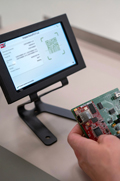
-
Chapter 5
Measuring and Monitoring Global Factory Health
Chapter 5 discusses the importance of measuring factory health through Overall Equipment Effectiveness (OEE). How do analytics at the line and factory level provide insights for continuous improvement? The role of OEE is critical in identifying bottlenecks, improving performance, and ensuring quality.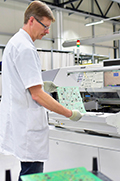
-
Chapter 6
Driving Meaningful Action
Chapter 6 emphasizes the importance of normalizing and labeling shop-floor data for analytics tools in PCBA manufacturing. Contextualized data is crucial for precise KPI calculations. Integrating factory analytics with production control systems can drive meaningful improvements in manufacturing operations by identifying issues, reducing errors, and maximizing production efficiency.
Print-on-demand paperbacks are available for this title. Click below to order from our distributor.
What Our Readers Are Saying
I would recommend that any data-driven engineers focused on taking their manufacturing operations to the next level read this book.
Jason Sciberras, President, Saline Lectronics Division of Emerald Technologies
Factory Analytics is great reading! Data analytics provides evidence of sustained performance and continuous improvement. This book also covers new tools like machine learning and how AI will bring new levels of factory analytics and efficiency.
Alejandro Carrillo, Founder/General Manager, InterLatin
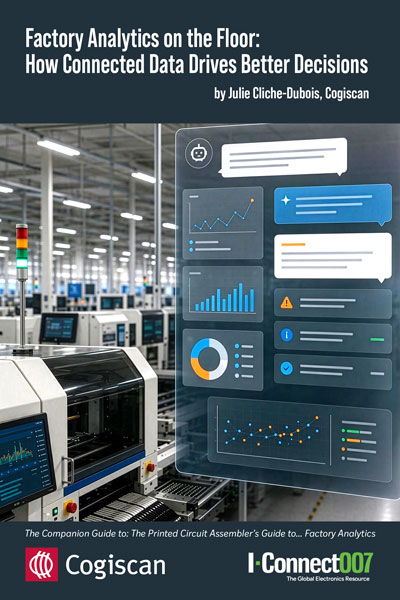
The Companion Guide to... Factory Analytics
This companion guide to The Printed Circuit Assembler's Guide to... Factory Analytics explores how connected factory analytics and AI-assisted investigation can turn manufacturing data into actionable intelligence. Follow a production day through the perspectives of an operator, quality engineer, and manufacturing engineer, and learn how data from machines, inspection systems, rework, and operator experience can reveal issues that traditional KPIs might miss. Readers see how deeper analysis of first-pass yield, false alarms, scrap, placement performance, and process conditions can accelerate root-cause analysis and improve decision-making. The guide also examines AI’s role in connecting disparate data and identifying patterns—while keeping human expertise central to validation and corrective action.