








 Alpha Insights, Performance by Design: Understanding Heat at the Core of Every Design
 It’s Only Common Sense: Excuses Don’t Pay Invoices
 Trouble in Your Tank: Understanding Interconnect Defects, Part 1





MIT School of Engineering and Takeda Join to Advance Research in Artificial Intelligence and Health
January 9, 2020 | MITEstimated reading time: 2 minutes
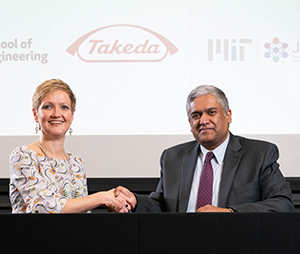
MIT’s School of Engineering and Takeda Pharmaceuticals Company Limited today announced the MIT-Takeda Program to fuel the development and application of artificial intelligence (AI) capabilities to benefit human health and drug development. Centered within the Abdul Latif Jameel Clinic for Machine Learning in Health (J-Clinic), the new program will leverage the combined expertise of both organizations, and is supported by Takeda’s three-year investment (with the potential for a two-year extension).
This new collaboration will provide MIT with extraordinary access to pharmaceutical infrastructure and expertise, and will help to focus work on challenges with lasting, practical impact. A new educational program offered through J-Clinic will provide Takeda with the ability to learn from and engage with some of MIT's sharpest and most curious minds, and offer insight into the advances that will help shape the health care industry of tomorrow.
“We are thrilled to create this collaboration with Takeda,” says Anantha Chandrakasan, dean of MIT’s School of Engineering. “The MIT-Takeda Program will build a community dedicated to the next generation of AI and system-level breakthroughs that aim to advance healthcare around the globe.”
The MIT-Takeda Program will support MIT faculty, students, researchers, and staff across the Institute who are working at the intersection of AI and human health, ensuring that they can devote their energies to expanding the limits of knowledge and imagination. The new program will coalesce disparate disciplines, merge theory and practical implementation, combine algorithm and hardware innovations, and create multidimensional collaborations between academia and industry.
“We share with MIT a vision where next-generation intelligent technologies can be better developed and applied across the entire health care ecosystem,” says Anne Heatherington, senior vice president and head of Data Sciences Institute (DSI) at Takeda. “Together, we are creating an incredible opportunity to support research, enhance the drug development process, and build a better future for patients.”
Established within J-Clinic, a nexus of AI and health care at MIT, the MIT-Takeda Program will focus on the following offerings:
- Funding 6-10 flagship research projects per year in the areas of machine learning and health, engaging MIT faculty and Takeda researchers on areas of mutual interest to both organizations including diagnosis of disease, prediction of treatment response, development of novel biomarkers, process control and improvement, drug discovery, and clinical trial optimization;
- Providing 11 annual fellowships supporting graduate students working at the intersection of AI and health, creating substantial, value-added programming for young scholars; and
- Offering educational programs through J-Clinic for Takeda employees to bolster individual and organizational learning in integrating AI and machine learning technologies into practical and applied solutions.
James Collins will serve as faculty lead for the MIT-Takeda Program. Collins is the Termeer Professor of Medical Engineering and Science in MIT’s Institute for Medical Engineering and Science (IMES) and Department of Biological Engineering, J-Clinic faculty co-lead, and a member of the Harvard-MIT Health Sciences and Technology faculty. He is also a core founding faculty member of the Wyss Institute for Biologically Inspired Engineering at Harvard University and an Institute Member of the Broad Institute of MIT and Harvard.
A joint steering committee co-chaired by Anantha Chandrakasan and Anne Heatherington will oversee the MIT-Takeda Program.
Share on:


Testimonial
"In a year when every marketing dollar mattered, I chose to keep I-Connect007 in our 2025 plan. Their commitment to high-quality, insightful content aligns with Koh Young’s values and helps readers navigate a changing industry. "
Brent Fischthal - Koh YoungSuggested Items
The Technical Backbone of an EMS Company: A CEO’s Perspective
11/12/2025 | Jay Rupani, Precision PCBAs the CEO of an EMS company, I often say that our business runs on precision, innovation, and trust. Behind every finished product—whether it’s a medical device, an automotive control module, or a consumer gadget—lies a sophisticated technical ecosystem that makes it all possible. From design support and process engineering to automation, data analytics, and supply chain integration, the technical side of EMS is where our value truly shines.
Indium Promotion Reflects Hertline’s Leadership in Advancing Innovative Soldering Solutions for Power Electronics
11/07/2025 | Indium CorporationAs industries worldwide accelerate toward electrification, automation, and smarter technologies, Indium Corporation, a global leader in advanced materials, is strengthening its leadership in engineered solder materials (ESM) to meet the growing demand for innovative, high-reliability solutions.
TTCI Brings Hands-On Test Engineering and IPC Training Expertise to PCB Carolina 2025
10/31/2025 | The Test Connection Inc.The Test Connection Inc. (TTCI), a trusted provider of electronic test and manufacturing solutions, and The Training Connection LLC (TTC-LLC) will exhibit at PCB Carolina on Wednesday, November 12, 2025, at the McKimmon Center at NC State University in Raleigh, North Carolina. Attendees can visit Table 4 to say hello to Bert Horner and Bill Graver, and learn more about their test engineering services and technical training programs.
BTU International Earns 2025 Step-by-Step Excellence Award for Its Aqua Scrub™ Flux Management System
10/29/2025 | BTU International, Inc.BTU International, Inc., a leading supplier of advanced thermal processing equipment for the electronics manufacturing market, has been recognized with a 2025 Step-by-Step Excellence Award (SbSEA) for its Aqua Scrub™ Flux Management Technology, featured on the company’s Pyramax™ and Aurora™ reflow ovens.
China Plus One: Vietnam and Thailand Manufacturing Solutions
10/28/2025 | Marcy LaRont, PCB007 MagazineU.S. electronics manufacturing companies are weighing the “China Plus One” solution as they strategize how best to mitigate the ever-increasing pressures and costs of manufacturing in China. Several global markets, particularly Thailand and Vietnam, are seeing significant growth in their sectors. This article breaks down the pros and cons of each market, including a look at U.S. tariffs and how each country is addressing a significant skilled labor gap to support their electronics manufacturing goals.