















 It’s Only Common Sense: Build Your Business on Reputation, Not Neglect
 The Marketing Minute: If Your Marketing Budget Gets Cut in Half, Then What?





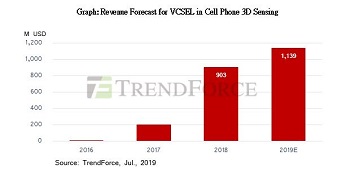
According to the latest Infrared Sensing Application Market Trend Report by LEDinside, a division of TrendForce, seeing that smartphone shipments are predicted to decline for whole 2019 year, cellphone brands will be engaging in a 'specs-contest' with their flagship devices for the second half-year, and 3D sensing modules will become an important component in that race. Market revenue for VCSELs used by cell phones utilizing 3D sensing is projected to reach $1.139 billion as a result of this trend.
“For 2019, besides Apple, who will be implementing 3D face recognition in its iPhones wholesale, Samsung, Huawei and Sony have also scheduled implementations of world-facing 3D sensing in flagship devices in 2H. It is estimated that near to 10 high-end phones may use 3D sensing solutions in 2020, with some devices going so far as to implement the solution on both the front- and world-facing cameras and pushing up VCSEL revenue,” says TrendForce Research Manager Joanne Wu.
VCSEL Suppliers Actively Developing World-facing TOF Camera Solutions
The 3D sensing solutions currently used in the consumer market are structured light and time-of-flight (TOF). Structured light acquires the image through projected light patterns, and is able to determine depth with extreme precision, though it comes with a high cost and computational complexity. Moreover, Apple holds the patent for the technology, forming a formidable patent barrier.
TOF does not enjoy the precision and depth that structured light does, but its fast reaction speeds and detection range make up for it. TOF cameras may be divided into front-facing and world-facing versions, with front-facing cameras costing more and world-facing cameras using the higher power VCSELs. Major VCSEL-related companies currently include Lumentum, Finisar, OSRAM's Vixar, ams, WIN Semiconductors Corp., Advanced Wireless Semiconductor Company (AWSC), VIAVI Solutions Inc. etc.
Android Players Eager to Penetrate Market for Varied VCSEL Applications
Many acquisitions and investments have taken place in the VCSEL market between 2017 and 2018, demonstrating that suppliers are optimistic towards future VCSEL demand. Since Apple adopted 3D sensing features in its iPhones wholesale in 2018, using it for face recognition and face unlock, many non-Apple companies such as Xioami, Huawei and OPPO caught on and began development. Yet there are serious bottlenecks in 3D sensing technology as well as a patent barrier, causing development by members of the Android camp to be slower than anticipated. Yet many cellphone brands still see 3D sensing as a technology with much potential.
As the 3D sensing market emerges, 3D sensing technology in future cellphones will no longer be limited to simple face recognition and face unlock applications, but extend to 3D object recognition, modeling, AR and various other features.