














 The Marketing Minute: If Your Marketing Budget Gets Cut in Half, Then What?
 Punching Out: How Are the Big Boys in Electronics Doing?
 It’s Only Common Sense: Complexity Is the Enemy of Profit





An Electrifying Improvement in Copper Conductivity
December 28, 2023 | PNNLEstimated reading time: 2 minutes
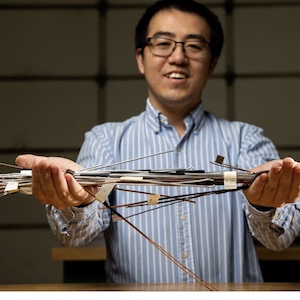
A common carbon compound is enabling remarkable performance enhancements when mixed in just the right proportion with copper to make electrical wires. It’s a phenomenon that defies conventional wisdom about how metals conduct electricity. The findings, reported December 2023 in the journal Materials & Design, could lead to more efficient electricity distribution to homes and businesses, as well as more efficient motors to power electric vehicles and industrial equipment. The team has applied for a patent for the work, which was supported by the Department of Energy (DOE) Advanced Materials and Manufacturing Technologies Office.
Materials scientist Keerti Kappagantula and her colleagues at DOE’s Pacific Northwest National Laboratory discovered that graphene, single layers of the same graphite found in pencils, can enhance an important property of metals called the temperature coefficient of resistance. This property explains why metal wires get hot when electric current runs through them. Researchers want to reduce this resistance while enhancing a metal’s ability to conduct electricity. For several years they have been asking whether metal conductivity be increased, especially at high temperatures, by adding other materials to it. And if yes, can these composites be viable at commercial scale?
Now, they’ve demonstrated they can do just that, using a PNNL-patented advanced manufacturing platform called ShAPE™. When the research team added 18 parts per million of graphene to electrical-grade copper, the temperature coefficient of resistance decreased by 11 percent without decreasing electrical conductivity at room temperature. This is relevant for the manufacturing of electric vehicle motors, where an 11 percent increase in electrical conductivity of copper wire winding translates into 1 percent gain in motor efficiency.
“This discovery runs counter to what’s generally known about the behavior of metals as conductors,” said Kappagantula. “Typically, introducing additives into a metal increases its temperature coefficient of resistance, meaning they heat up faster at the same current levels compared to pure metals. We are describing a new and exciting property of this metal composite where we observe enhanced conductivity in a manufactured copper wire.”
Share on:



Subscribe
Stay ahead of the technologies shaping the future of electronics with our latest newsletter, Advanced Electronics Packaging Digest. Get expert insights on advanced packaging, materials, and system-level innovation, delivered straight to your inbox.
Subscribe now to stay informed, competitive, and connected.
Suggested Items
The 2027 Defense Deadline That is Forcing the U.S. to Rebuild 40 Years of Lost Tech
05/13/2026 | PRNewswireRoughly 40 years ago, the United States made a decision that seemed perfectly rational at the time: it stopped processing rare earths.
Volatile Metals Market Creates PCB Pricing Headache
04/20/2026 | Nolan Johnson, I-Connect007Market volatility for precious metals is very real. Financial organizations have reported elevated volatility, with record highs and steep corrections; in 2025 alone, gold has increased by over 60%, silver over 120%, and copper over 35%. Each is a critical raw material used in electronics manufacturing, where pricing is already fraught for business owners and their customers due to tariff uncertainty and a critical supply chain that resides mostly in China. The volatility of precious metals markets adds yet another layer of complexity for manufacturers, pushing up raw material costs.
Indium Corporation Announces Strategic Agreement for Domestic Critical Metals Recovery
04/06/2026 | Indium CorporationIndium Corporation®, an industry leader in innovative materials solutions for semiconductor packaging and electronics assembly, announced that it has executed a long-term offtake framework agreement with Flash Metals USA Inc., a wholly owned subsidiary of Metallium Limited (MTM), for the supply of critical metals recovered using Metallium’s Flash Joule Heating technology.
China Halts Gallium, Germanium, Antimony Ban for US, But Licensing Still Required
11/10/2025 | I-Connect007 Editorial TeamChina has suspended a ban on exports of gallium, germanium, and antimony to the United States, Reuters reported. However, China’s commerce ministry stated on Nov. 9 that Beijing’s licenses are still required for wider export restrictions on the metals.
Coherent Evaluates Strategic Alternatives for Its Advanced Lithium-Ion Battery Recycling Technology
12/13/2024 | Globe NewswireCoherent Corp., a global leader in materials, networking, and lasers, today announced that as a result of an ongoing strategic portfolio assessment, the company will evaluate strategic alternatives for its Streamlined Hydrometallurgical Advanced Recycling Process (SHARP™) technology to efficiently recover and recycle critical metals from lithium-ion batteries (LiBs).