













 It’s Only Common Sense: Win the Sale Before the RFQ Arrives
 The Marketing Minute: Marketing Is a Team Sport





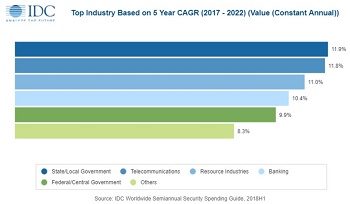
Worldwide spending on security-related hardware, software, and services is forecast to reach $103.1 billion in 2019, an increase of 9.4% over 2017. This pace of growth is expected to continue for the next several years as industries invest heavily in security solutions to meet a wide range of threats and requirements. According to the Worldwide Semiannual Security Spending Guide from International Data Corporation (IDC), worldwide spending on security solutions will achieve a compound annual growth rate (CAGR) of 9.2% over the 2018-2022 forecast period and total $133.8 billion in 2022.
The three industries that will spend the most on security solutions in 2019—banking, discrete manufacturing, and federal/central government—will invest more than $30 billion combined. Three other industries (process manufacturing, professional services, and telecommunications) will each see spending greater than $6.0 billion this year. The industries that will experience the fastest spending growth over the forecast period will be state/local government (11.9% CAGR), telecommunications (11.8% CAGR), and the resource industries (11.3% CAGR). This spending growth will make telecommunications the fourth largest industry for security spending in 2022 while state/local government will move into the sixth position ahead of professional services.
"When examining the largest and fastest growing segments for security, we see a mix of industries—such as banking and government—that are charged with guarding highly sensitive information in regulated environments. In addition, information-based organizations like professional services firms and telcos are ramping up spending. But regardless of industry, these technologies remain an investment priority in virtually all enterprises, as delivering a sense of security is everyone's business," said Jessica Goepfert, program vice president, Customer Insights and Analysis.
Managed security services will be the largest technology category in 2019 with firms spending more than $21 billion for around-the-clock monitoring and management of security operations centers. Managed security services will also be the largest category of spending for each of the top five industries this year. The second largest technology category in 2019 will be network security hardware, which includes unified threat management, firewalls, and intrusion detection and prevention technologies. The third and fourth largest investment categories will be integration services and endpoint security software. The technology categories that will see the fastest spending growth over the forecast will be managed security services (14.2% CAGR), security analytics, intelligence, response and orchestration software (10.6% CAGR), and network security software (9.3% CAGR).
"The security landscape is changing rapidly, and organizations continue to struggle to maintain their own in-house security solutions and staff. As a result, organizations are turning to managed security service providers (MSSPs) to deliver a wide span of security capabilities and consulting services, which include predicative threat intelligence and advanced detection and analysis expertise that are necessary to overcome the security challenges happening today as well as prepare organizations against future attacks," said Martha Vazquez, senior research analyst, Infrastructure Services.
From a geographic perspective, the United States will be the single largest market for security solutions with spending forecast to reach $44.7 billion in 2019. Two industries—discrete manufacturing and the federal government—will account for nearly 20% of the U.S. total. The second largest market will be China where security purchases by three industries—state/local government, telecommunications, and central government—will comprise 45% of the national total. Japan and the UK are the next two largest markets with security spending led by the consumer sector and the banking industry respectively.
Page 1 of 2


