












A Chameleon-Inspired Smart Skin Changes Color in the Sun
September 11, 2019 | American Chemical SocietyEstimated reading time: 2 minutes
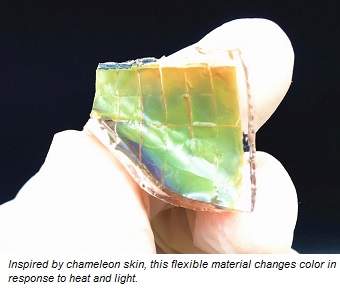
Some creatures, such as chameleons and neon tetra fish, can alter their colors to camouflage themselves, attract a mate or intimidate predators. Scientists have tried to replicate these abilities to make artificial "smart skins," but so far the materials haven't been robust. Now, researchers reporting in ACS Nano have taken a page from the chameleon's playbook to develop a flexible smart skin that changes its color in response to heat and sunlight.
The hues of chameleon skin rely not on dyes or pigments as most colors do, but instead on arrays of tiny structures known as photonic crystals. Light reflects from these microscopic surfaces and interferes with other beams of reflected light, producing a color. The hue changes when the distance between photonic crystals varies—for example, when a chameleon tenses or relaxes its skin. To mimic these natural abilities, scientists have embedded photonic crystals in flexible materials, such as hydrogels, and changed their colors by contracting or expanding the material like an accordion. However, these large fluctuations in size can strain the materials and cause them to buckle. Khalid Salaita and colleagues wanted to take a closer look at chameleon skin and use what they learned to design a strain-accommodating smart skin.
By watching time-lapse images of chameleon skin, the researchers noticed that only a small fraction of skin cells actually contain photonic crystal arrays, while the rest are colorless. The team reasoned that the colorless cells might help accommodate the strain when the photonic crystals contract and expand. Inspired by this observation, the researchers patterned arrays of photonic crystals in a hydrogel and then embedded these arrays in a second, non-color-changing hydrogel that acted as a supporting layer. Upon heating, the resulting material changed color but remained the same size. The smart skin also altered its hue in response to natural sunlight, similar to how a tetra fish does. The new material could someday find applications in camouflage, signaling and anti-counterfeiting, the researchers say.
Subscribe
Stay ahead of the technologies shaping the future of electronics with our latest newsletter, Advanced Electronics Packaging Digest. Get expert insights on advanced packaging, materials, and system-level innovation, delivered straight to your inbox.
Subscribe now to stay informed, competitive, and connected.
Suggested Items
AI Demand Drives PCB Material Market Growth
05/08/2026 | TPCAAs AI computing continues to drive a comprehensive upgrade in hardware specifications, the global printed circuit board industry is undergoing a profound structural transformation.
I-Connect007 Editor’s Choice: Five Must-Reads for the Week
05/01/2026 | Michelle Te, I-Connect007If it feels like the PCB industry is accelerating faster than ever, you’re not imagining it. From advanced materials driven by AI applications to renewed investment in domestic manufacturing—and the next generation stepping into critical roles—there’s a lot shifting at once. My selections for this week highlight where the pressure points are forming, and where the opportunities are emerging.
Electronics Manufacturing Needs Your Voice: Global Sentiment Survey Now Live
04/30/2026 | Global Electronics AssociationThe latest monthly Global Sentiment Survey from the Global Electronics Association is now open. At a time when demand uncertainty, policy shifts, energy costs, and supply chain recalibration are pulling the industry in multiple directions, the survey captures something macroeconomic data often misses: how manufacturers are actually experiencing conditions on the ground.
From Backbone to Breakthroughs: I-Connect007 Wraps PCB Materials Series with Focus on Innovation
05/06/2026 | I-Connect007I-Connect007 wraps up its six-part podcast series, PCB Materials: The Backbone and Future of Electronics, with Episode 6 and a discussion focusing on innovation. In Episode 6, Marcy LaRont speaks with Isola CTO Kirk Thompson about a critical turning point for the PCB industry as innovation accelerates. As data rates climb and demands from AI infrastructure, power density, flexible electronics, photonics, and chiplet integration intensify, traditional material assumptions are no longer sufficient.
Jiva Soluboard Getting the Attention It Deserves
04/30/2026 | Marcy LaRont, I-Connect007 MagazineJiva is a newer company that bridges the divide between PCB fabrication and product circularity or sustainability. Jiva Soluboard is the first fully recyclable laminate material ever created for PCB fabrication, and it's not going unnoticed. Stephen Driver, CEO of Jiva, gave us an update at APEX EXPO, including an exciting certification achievement in February.