














 It’s Only Common Sense: How AI Consumes the Electronics Supply Chain
 Dan’s Biz Bookshelf: ‘Building a Story Brand 2.0’





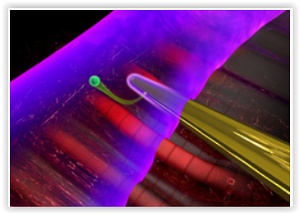
The researchers sent strong infrared laser pulses onto a gold nanowire. These laser pulses are so short that they are composed of only a few oscillations of the light field. When the light illuminated the nanowire it excited collective vibrations of the conducting electrons surrounding the gold atoms. Through these electron motions, near-fields were created at the surface of the wire.
The physicists wanted to study the timing of the near-fields with respect to the light fields. To do this they sent a second light pulse with an extremely short duration of just a couple of hundred attoseconds onto the nanostructure shortly after the first light pulse. The second flash released individual electrons from the nanowire. When these electrons reached the surface, they were accelerated by the near-fields and detected. Analysis of the electrons showed that the near-fields were oscillating with a time shift of about 250 attoseconds with respect to the incident light, and that they were leading in their vibrations. In other words: the near-field vibrations reached their maximum amplitude 250 attoseconds earlier than the vibrations of the light field.
“Fields and surface waves at nanostructures are of central importance for the development of lightwave-electronics. With the demonstrated technique they can now be sharply resolved.”, explained Prof. Matthias Kling, the leader of the team carrying out the experiments in Munich.
The experiments pave the way towards more complex studies of light-matter interaction in metals that are of interest in nano-optics and the light-driven electronics of the future. Such electronics would work at the frequencies of light. Light oscillates a million billion times per second, i.e. with petahertz frequencies – about 100,000 times faster than electronics available at the moment. The ultimate limit of data processing could be reached.


