












 Punching Out: M&A North American PCB and EMS Deals for the First Half of 2025
 The Chemical Connection: Sales Organization from a Capital Equipment Perspective
 Marcy’s Musings: From Pitch to PO—The Sales Stack





3D-Printed ‘Bionic Skin’ Could Give Robots the Sense of Touch
May 12, 2017 | University of Minnesota College of Science and EngineeringEstimated reading time: 2 minutes
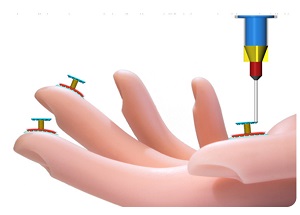
Engineering researchers at the University of Minnesota have developed a revolutionary process for 3D printing stretchable electronic sensory devices that could give robots the ability to feel their environment. The discovery is also a major step forward in printing electronics on real human skin.
“This stretchable electronic fabric we developed has many practical uses,” said Michael McAlpine, a University of Minnesota mechanical engineering associate professor and lead researcher on the study. “Putting this type of ‘bionic skin’ on surgical robots would give surgeons the ability to actually feel during minimally invasive surgeries, which would make surgery easier instead of just using cameras like they do now. These sensors could also make it easier for other robots to walk and interact with their environment.”
McAlpine, who gained international acclaim in 2013 for integrating electronics and novel 3D-printed nanomaterials to create a “bionic ear,” says this new discovery could also be used to print electronics on real human skin. This ultimate wearable technology could eventually be used for health monitoring or by soldiers in the field to detect dangerous chemicals or explosives.
“While we haven’t printed on human skin yet, we were able to print on the curved surface of a model hand using our technique,” McAlpine said. “We also interfaced a printed device with the skin and were surprised that the device was so sensitive that it could detect your pulse in real time.”
McAlpine and his team made the unique sensing fabric with a one-of-a kind 3D printer they built in the lab. The multifunctional printer has four nozzles to print the various specialized “inks” that make up the layers of the device—a base layer of silicone, top and bottom electrodes made of a conducting ink, a coil-shaped pressure sensor, and a sacrificial layer that holds the top layer in place while it sets. The supporting sacrificial layer is later washed away in the final manufacturing process.
Surprisingly, all of the layers of “inks” used in the flexible sensors can set at room temperature. Conventional 3D printing using liquid plastic is too hot and too rigid to use on the skin. These flexible 3D printed sensors can stretch up to three times their original size.
“This is a completely new way to approach 3D printing of electronics,” McAlpine said. “We have a multifunctional printer that can print several layers to make these flexible sensory devices. This could take us into so many directions from health monitoring to energy harvesting to chemical sensing.”
Researchers say the best part of the discovery is that the manufacturing is built into the process.
“With most research, you discover something and then it needs to be scaled up. Sometimes it could be years before it ready for use,” McAlpine said. “This time, the manufacturing is built right into the process so it is ready to go now.”
The researchers say the next step is to move toward semiconductor inks and printing on a real body.
“The possibilities for the future are endless,” McAlpine said.
In addition to McAlpine, the research team includes University of Minnesota Department of Mechanical Engineering graduate students Shuang-Zhuang Guo, Kaiyan Qiu, Fanben Meng, and Sung Hyun Park.
Share on:


Testimonial
"Our marketing partnership with I-Connect007 is already delivering. Just a day after our press release went live, we received a direct inquiry about our updated products!"
Rachael Temple - AlltematedSuggested Items
I-Connect007 Editor’s Choice: Five Must-Reads for the Week
07/25/2025 | Marcy LaRont, I-Connect007In industry news this past week, I’m putting a focus on sustainability in electronics by highlighting my interview with Kelly Scanlon and Corey Dehmey, and Nolan Johnson’s Meet the Author podcast with Beth Turner of MacDermid Alpha Electronics Solutions. I also chose to spotlight the M&A activity and outlook in the U.S. market and regional market news in India and Mexico.
From Factory Floor to ‘The Component Store’
07/25/2025 | Marcy LaRont, I-Connect007Daniel Beauvois began his career in PCB manufacturing 15 years ago with zero industry experience—just a willingness to learn. Daniel immersed himself in every step of circuit board production, from hanging out on the factory floor to giving plant tours. Now, as founder of The Component Store, he’s an independent sales rep known for integrity, persistence, and deep technical knowledge. In this interview, Daniel reflects on his journey, the realities of being an outside rep, and what it takes to earn—and keep—a customer’s trust in an ever-evolving electronics industry.
STMicroelectronics Reports Q2 2025 Financial Results
07/24/2025 | STMicroelectronicsSTMicroelectronics N.V., a global semiconductor leader serving customers across the spectrum of electronics applications, reported U.S. GAAP financial results for the second quarter ended June 28, 2025. This press release also contains non-U.S. GAAP measures.
Würth Elektronik Opens New Location in South Africa
07/24/2025 | Würth ElektronikOn June 1, 2025, a new Würth Elektronik branch opened in Brackenfell, Western Cape, South Africa. The location operates under the name Wurth Electronics South Africa (Pty.) Ltd and will serve local customers, but will also be responsible for the markets of Botswana, Mauritius, Namibia, Tanzania and Zambia.
Beyond Recycling: Reshaping Sustainability in Electronics
07/24/2025 | Marcy LaRont, PCB007 MagazineEnvironmental sustainability, especially for carbon-intensive industries like electronics manufacturing, means businesses are often plagued with various reporting requirements that don’t necessarily address the root problem. To that end, SERI and the Global Electronics Association are teaming up to reshape sustainability in electronics.