














 American Made Advocacy: While Congress Debates, America’s PCB Competitors Invest Billions
 Defense Speak Interpreted: The Impact of Venture Capital-backed Defense Contractor Firms





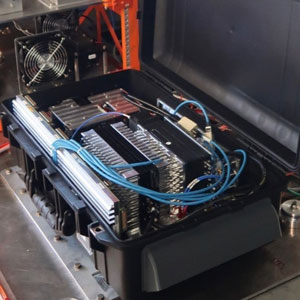
Lockheed Martin, in collaboration with Intel accomplished an industry first by successfully integrating a 5G Core and Open Radio Access Network (O-RAN) into Lockheed Martin's 5G.MIL Hybrid Base Station (HBS), providing decisive information dominance to operators across domains. By integrating Intel's FlexRAN reference architecture and Intel Xeon Scalable processors into a 3U tactical chassis, Lockheed Martin implemented open system communications gateway capabilities on flyable hardware using established modular open system architecture and 5G commercial standards. Working within a family of common open architectures ensures products and solutions are drop-in ready with no vendor lock.
Expert Perspectives
"The integration of 5G and military tactical radios into our Hybrid Base Station enables resilient, link-diverse data routing throughout the battlespace to make future crewed-uncrewed distributed teaming missions possible," said John G. Clark, vice president and general manager of Lockheed Martin Skunk Works®. "The Lockheed Martin 5G.MIL® HBS was designed using open mission systems standards so that the technology can onramp to multiple and varied platforms quickly in support of our customers' transformation vision."
"Lockheed Martin's latest innovation for HBS (Hybrid Base Station) highlights the type of highly flexible and portable data capabilities made possible by a virtualized and software-programmable architecture powered by Intel FlexRAN reference architecture and Intel Xeon processors," said Dan Rodriguez, corporate vice president and general manager of Intel's Network and Edge Solutions Group. "Our continuing collaboration on 5G.MIL showcases new abilities to strengthen DoD critical digital communications across Lockheed Martin's platforms."
Dive Deeper
By implementing the HBS within a 3U/VPX rugged form factor, Lockheed Martin demonstrated over-the-air 5G and tactical network connectivity in a laboratory environment that is capable of transitioning to military air vehicles. While most applications of 5G base station technology are data center centric, this demonstration hosted 5G O-RAN technology on ruggedized computers suitable for fighter and other aircraft, paving the way for the team to fly on any number of military platforms during upcoming crewed-uncrewed distributed teaming flight tests.
The demonstration also leveraged 3rd Gen Intel Xeon Scalable processors, which are designed to provide the greatest performance per watt. These processors enable a low Size, Weight and Power (SWaP) solution required by platforms operating at the tactical edge, significantly reducing the amount of hardware required to perform the same functionality.
What's Next?
This 3U/VPX HBS integration success positions the team for crewed-uncrewed flight testing next year as part of Lockheed Martin's Project Carrera. Additionally, Lockheed Martin and Intel continue to explore how to best bridge current applications of 5G commercial stacks with military datalinks to bring the most capable, resilient communications solutions to the Department of Defense. This includes next generation software defined radios capable of commercial 5G, as well as future waveform implementations to meet the objectives of crewed-uncrewed teaming. These advancements pave the way for operators to have greater connectivity, faster and more reliable networks, and enhanced interoperability in support of Joint All Domain Operations.


