












 Dan’s Biz Bookshelf: ‘The Next RenAIssance: AI and the Expansion of Human Potential’
 The Chemical Connection: When the Industry Moves Faster Than the Standards
 Driving Innovation: Selecting the Right Laser Source





BTQ, Hon Hai Research Institute Team Up To Help Pioneer Post-Quantum Cryptography Standards
November 30, 2023 |Estimated reading time: 2 minutes
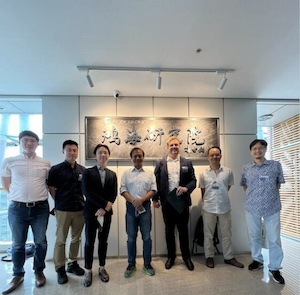
BTQ Technologies Corp., a publicly-listed and leading quantum technology company focused on securing mission-critical networks, is pleased to announce that, together with its wholly-owned unit BTQ AG, it has entered into a Research and Collaboration Agreement with Hon Hai Research Institute, a key think tank for Hon Hai Technology Group (Foxconn), the world's largest electronics manufacturer and a leading technological solution provider. The goal of the collaboration is to promote the standardization of post-quantum cryptography.
The collaboration between BTQ and Hon Hai Research Institute began two years ago and the efforts in PQC led to the submission of a milestone report under the Research Program to the US National Institute of Standards and Technology (NIST) on June 1, 2023. It addressed the "Call for Additional Digital Signature Schemes for the Post-Quantum Cryptography Standardization Process" and the co-authored report was formally published in July this year.
NIST launched the PQC standardization project in 2016, hoping to establish a complete encryption and decryption system and digital signature system, which will become a new generation of standardized cryptography systems. The significance of the recent publication is that its findings could have the opportunity to be adopted by the government and industry in the future and become one of the reference standards for future development. NIST is expected to announce the final version in 2024.
The contribution of Hon Hai Research Institute represents the forward-thinking direction in the field of post-quantum cryptography, which is in line with the trend of international academic research. The work to date is a great affirmation for BTQ and HHRI in jointly promoting research in this field. It sets a stronger foundation for the Research Program and the deepening partnership.
"We are pleased to have entered into this Agreement with Foxconn, a truly world-class and global organization at the forefront of cutting-edge technological innovation," said BTQ CEO Olivier Roussy Newton. "This contract strengthens our relationship with a long-term strategic partner and is a great testament to the quality of the scientific team BTQ has assembled to date. Additionally, Foxconn has demonstrated interest in the Canadian deep technology talent pool which opens the door to opportunities for various collaborations long-term. We look forward to building upon this relationship and bringing meaningful developments to the quantum industry."
"This partnership not only strengthens our relationship with BTQ, a dynamic and forward-thinking company, but also underscores the caliber of our scientific team and their dedication to advancing the field of post-quantum cryptography," said Hon Hai Research Institute CEO Wei-bin Lee. "Our recent participation in the NIST PQC submission demonstrates the significant contributions we have already made to the advancement of PQC. We look forward to a fruitful collaboration that will drive progress in the field."
NIST PQC Standardization
In response to the significant progress and development in quantum computing, The National Institute of Standards and Technology (NIST) launched a public process to identify quantum-resistant public-key cryptographic algorithms for standardization. The process began with a public call for submissions to the post quantum cryptography (PQC) Standardization Process in December 2016. After three rounds of evaluation and analysis over several years, NIST announced the first set of algorithms to be standardized in 2022. This marked an important step towards ensuring the security of digital infrastructure against the growing threat posed by quantum computing. Now, NIST is continuing the PQC standardization process with a fourth round, in which NIST is calling for additional digital signature proposals to be considered in the PQC standardization process.
Share on:



Subscribe
Stay ahead of the technologies shaping the future of electronics with our latest newsletter, Advanced Electronics Packaging Digest. Get expert insights on advanced packaging, materials, and system-level innovation, delivered straight to your inbox.Subscribe now to stay informed, competitive, and connected.
Suggested Items
Sygaldry Raises $139M to Build Quantum Computers for AI
04/22/2026 | SygaldrySygaldry Technologies, Inc. announced that it has raised $139M in Series A and Seed financing to build quantum-accelerated AI servers.
IBM, UIUC Expand Discovery Accelerator for AI and Quantum Computing
04/20/2026 | PRNewswireIBM and the Grainger College of Engineering at the University of Illinois Urbana-Champaign (U. of I.) announced an expansion of the IBM-Illinois Discovery Accelerator Institute.
DARPA Launches HARQ Program to Integrate Diverse Qubits for Scalable Quantum Computing
04/20/2026 | DARPADARPA has launched the Heterogeneous Architectures for Quantum (HARQ) program, an effort aimed at overcoming one of the most persistent barriers in quantum computing: how to move beyond single-technology systems to achieve and scale practical, high-impact applications.
From AI to AEP, an Impressive Array of Keynotes at APEX EXPO 2026
04/17/2026 | Marcy LaRont and Nolan Johnson, I-Connect007Each year at APEX EXPO, the Global Electronics Association provides an impressive lineup of keynote speakers to kick off the largest electronics manufacturing event in North America. This year included four keynote speeches, on topics ranging from the promise and peril of AI to the power of electronics, quantum computing, and the importance of heterogeneous integration in advanced electronics packaging.
IBM's David Lokken-Toyli: Quantum’s Call to ‘Leap’
04/10/2026 | Marcy LaRont, I-Connect007What happens when a cutting-edge quantum computer is placed in the middle of a public cafeteria? For David Lokken-Toyli, principal research scientist at IBM Quantum, that image, now a reality at Cleveland Clinic, captures a turning point: Quantum computing is moving out of the lab and into the real world, and getting there will depend not just on physicists, but on an electronics supply chain ready to support entirely new system requirements.