

















 It’s Only Common Sense: Customers Capabilities—and Confidence
 Marcy’s Musings: Operating Without a Rulebook
 Dan’s Biz Bookshelf: ‘The 'NVIDIA Way: Jensen Huang and the Making of a Tech Giant’





North American PCB Business Growth Continued in April
May 31, 2016 | IPCEstimated reading time: 3 minutes
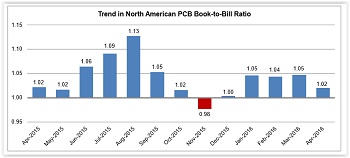
IPC — Association Connecting Electronics Industries® announced today the April 2016 findings from its monthly North American Printed Circuit Board (PCB) Statistical Program. Sales and orders in April both exceeded last year’s levels and the book-to-bill ratio stands at 1.02.
Total North American PCB shipments in April 2016 were 5.6% above the same month last year, causing year-to-date growth to remain at 5.5% for the first four months of the year. Compared to the preceding month, April shipments were down 16.8%.
PCB bookings in April increased 6.4% year-on-year, boosting year-to-date bookings growth for the first quarter to 5.0%. Orders in April 2016 were down 19.3% from the previous month.
“April was another good month for the North American PCB industry, with solid year-on-year growth in both sales and orders,” said Sharon Starr, IPC’s director of market research. “Bookings exceeded shipments for the sixth consecutive month, but only by a small margin in April. This brought the book-to-bill ratio down although it remains positive,” she added. “Growth rates and book-to-bill ratios for the first quarter changed slightly from previously published reports, due to a re-tabulation necessitated by a change in the survey sample this month. The revised ratios are 1.05 in January, 1.04 in February and 1.05 in March. April’s 1.02 book-to-bill continues a positive trend indicating continued sales growth in the second and third quarters.”
Detailed Data Available
The next edition of IPC’s North American PCB Market Report, containing detailed April data from IPC’s PCB Statistical Program, will be available by the end of next week. The monthly report presents detailed findings on rigid PCB and flexible circuit sales and orders, including separate rigid and flex book-to-bill ratios, military and medical market growth, demand for prototypes, and other timely data. This report is available free to current participants in IPC’s PCB Statistical Program and by subscription to others. More information about this report can be found at www.ipc.org/market-research-reports.
Interpreting the Data
The book-to-bill ratios are calculated by dividing the value of orders booked over the past three months by the value of sales billed during the same period from companies in IPC’s survey sample. A ratio of more than 1.00 suggests that current demand is ahead of supply, which is a positive indicator for sales growth over the next three to six months. A ratio of less than 1.00 indicates the reverse.
Year-on-year and year-to-date growth rates provide the most meaningful view of industry growth. Month-to-month comparisons should be made with caution as they reflect seasonal effects and short-term volatility. Because bookings tend to be more volatile than shipments, changes in the book-to-bill ratios from month to month might not be significant unless a trend of more than three consecutive months is apparent. It is also important to consider changes in both bookings and shipments to understand what is driving changes in the book-to-bill ratio.
IPC’s monthly PCB industry statistics are based on data provided by a representative sample of both rigid PCB and flexible circuit manufacturers selling in the USA and Canada. IPC publishes the PCB book-to-bill ratio at the end of each month. Statistics for the current month are normally available in the last week of the following month.
About IPC
IPC is a global industry association based in Bannockburn, Ill., dedicated to the competitive excellence and financial success of its 3,700 member companies which represent all facets of the electronics industry, including design, printed board manufacturing, electronics assembly and test. As a member-driven organization and leading source for industry standards, training, market research and public policy advocacy, IPC supports programs to meet the needs of an estimated $2 trillion global electronics industry. IPC maintains additional offices in Taos, N.M.; Washington, D.C.; Atlanta, Ga.; Stockholm, Sweden; Brussels, Belgium; Moscow, Russia; Bangalore and New Delhi, India; Bangkok, Thailand; and Qingdao, Shanghai, Shenzhen, Chengdu, Suzhou and Beijing, China.
Share on:


Testimonial
"In a year when every marketing dollar mattered, I chose to keep I-Connect007 in our 2025 plan. Their commitment to high-quality, insightful content aligns with Koh Young’s values and helps readers navigate a changing industry. "
Brent Fischthal - Koh YoungSuggested Items
SMTA Announces 2026 STAR Forum Technical Program
04/16/2026 | SMTAThe SMTA announced the finalized program for the High Reliability: Strategic Technology Advancement Research Forum which takes place on May 6-7, 2026 in Olathe, Kansas, USA.
From AI to AEP, an Impressive Array of Keynotes at APEX EXPO 2026
04/17/2026 | Marcy LaRont and Nolan Johnson, I-Connect007Each year at APEX EXPO, the Global Electronics Association provides an impressive lineup of keynote speakers to kick off the largest electronics manufacturing event in North America. This year included four keynote speeches, on topics ranging from the promise and peril of AI to the power of electronics, quantum computing, and the importance of heterogeneous integration in advanced electronics packaging.
Breaking the Manual Quoting Bottleneck in Wire Harness
04/15/2026 | Nolan Johnson, SMT007 MagazineArik Vrobel has spent more than 35 years in wire harness manufacturing—starting in EL-Com, his father's shop, building it into a nationally recognized contract manufacturer, and ultimately selling to Aptiv/Winchester in 2021. But retirement didn't last long. Within months, Arik was back, not as a manufacturer this time, but as a technologist. His new company, Cableteque, is building the quoting and data automation platform he always wished existed.
Podcast Hits the Mark in a Materials Market
04/15/2026 | Marcy LaRont, I-Connect007The base material of a printed circuit board is its literal and functional foundation. Isola, founded in 1912 in Düren, Germany, is one of the longest-standing manufacturers of glass-reinforced laminates in the electronics industry. Originally focused on insulation and fiberglass materials, the company played an early role in supplying the foundational substrates that enabled the growth of PCB technology. As electronics advanced, Isola evolved alongside the industry, expanding from basic glass-epoxy laminates into high-performance copper-clad materials and engineered prepregs.
New EIPC President: Building Strength Through Unity in Europe’s Electronics Industry
04/14/2026 | Marcy LaRont, I-Connect007Industry veteran Rico Schluter, newly appointed president of EIPC, discusses his decades-long journey through the European PCB industry and his vision for its future. From building advanced manufacturing operations to leading large-scale facility development in Lithuania, Rico shares insights into automation, workforce evolution, and the challenges of scaling production. He emphasizes the urgent need for stronger collaboration across European industry organizations to effectively influence policy in Brussels, particularly around supply chain resilience, trade regulations, and energy-related incentives.