















 American Made Advocacy: While Congress Debates, America’s PCB Competitors Invest Billions
 Defense Speak Interpreted: The Impact of Venture Capital-backed Defense Contractor Firms





An A*STAR researcher has, together with an international team, uncovered an exception to the longstanding rule that effective heat-conducting metals are also good conduits for electricity. This anomaly could eventually be harnessed in thermoelectric devices that convert waste heat from appliances and engines into useful electric power.
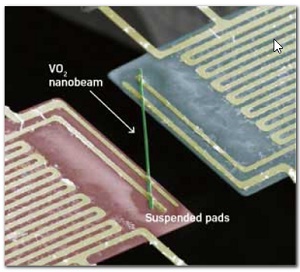
By measuring heat flow from a heating pad (red) to a sensing pad (blue) along a nanorod (green) made of metallic vanadium dioxide, A*STAR researchers found that the almost universal relation between heat conductivity and thermal conductivity breaks down spectacularly. (AAAS)
Metals conduct both heat and electricity, which is why they are used to make frying pans as well as electrical wires. This is because electrons can flow freely in metals, carrying thermal energy and electrical charge with them as they move.
This phenomenon is so universal that it has been enshrined in an empirical rule known as the Wiedemann–Franz law, which was discovered more than 150 years ago. While some metals that break this law have been found in recent years, these exceptions usually occur at very low temperatures close to absolute zero, making them impractical for use in applications such as thermoelectric devices and thermal switches.
Now, Kedar Hippalgaonkar at the A*STAR Institute of Materials Research and Engineering and collaborators in an international team have found a large deviation from this law at temperatures above room temperature (Science, "Anomalously low electronic thermal conductivity in metallic vanadium dioxide.").
Specifically, by measuring heat flow along a vanadium dioxide (VO2) nanorod (see image), they discovered that the thermal conductivity attributable to the electrons in the material is ten times lower than that predicted by the Wiedemann–Franz law.
The effect was observed in the temperature range -33 to 67 degrees Celsius. Above 67 degrees Celsius, vanadium dioxide suddenly switches from being an electrical insulator to a conductor, accompanied by a small change in its crystal structure.
“This deviation is only possible because of new physics that govern the motion of collective electrons in this unique class of materials, which exhibit a similar metal-to-insulator transition,” says Hippalgaonkar. “In particular, in metallic vanadium dioxide, electrons flow like a liquid, which manifests as them carrying charge effectively, but not heat.” This electron movement contrasts with the more random movement of electrons in a regular metal, which resembles that of molecules in a gas.
It is also possible to tune the heat conduction of vanadium dioxide by introducing tungsten as an impurity. This ability could be exploited in thermal switches.
“Our study puts the spotlight on the class of materials that exhibit a metal-to-insulator transition as well as those harboring correlated electron systems,” says Hippalgaonkar. “It’s just the beginning. As well as exploring other material systems that provide improved performance compared to this proof-of-concept study, we intend to delve deeper into the physics underlying this phenomenon.”


