















 Punching Out: How Are the Big Boys Doing Now?
 It’s Only Common Sense: Every Salesperson Must Become a Teacher
 Trouble in Your Tank: Are PCB Fabricators Ready for the Next Technology Curve?





Robots are good at making identical repetitive movements, such as a simple task on an assembly line. (Pick up a cup. Turn it over. Put it down.) But they lack the ability to perceive objects as they move through an environment. (A human picks up a cup, puts it down in a random location, and the robot must retrieve it.) A recent study was conducted by researchers at the University of Illinois at Urbana-Champaign, NVIDIA, the University of Washington, and Stanford University, on 6D object pose estimation to develop a filter to give robots greater spatial perception so they can manipulate objects and navigate through space more accurately.
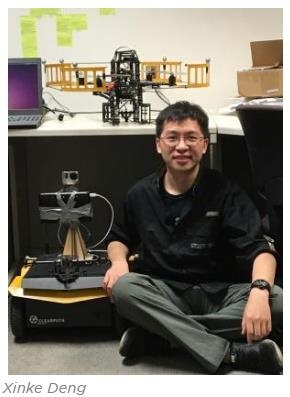
While 3D pose provides location information on X, Y, and Z axes—relative location of the object with respect to the camera—6D pose gives a much more complete picture. “Much like describing an airplane in flight, the robot also needs to know the three dimensions of the object’s orientation—its yaw, pitch, and roll,” said Xinke Deng, doctoral student studying with Timothy Bretl, an associate professor in the Dept. of Aerospace Engineering at U of I.
And in real-life environments, all six of those dimensions are constantly changing.
“We want a robot to keep tracking an object as it moves from one location to another,” Deng said.
Deng explained that the work was done to improve computer vision. He and his colleagues developed a filter to help robots analyze spatial data. The filter looks at each particle, or piece of image information collected by cameras aimed at an object to help reduce judgement errors.
“In an image-based 6D pose estimation framework, a particle filter uses a lot of samples to estimate the position and orientation,” Deng said. “Every particle is like a hypothesis, a guess about the position and orientation that we want to estimate. The particle filter uses observation to compute the value of importance of the information from the other particles. The filter eliminates the incorrect estimations.
“Our program can estimate not just a single pose but also the uncertainty distribution of the orientation of an object,” Deng said. “Previously, there hasn’t been a system to estimate the full distribution of the orientation of the object. This gives important uncertainty information for robot manipulation.”
The study uses 6D object pose tracking in the Rao-Blackwellized particle filtering framework, where the 3D rotation and the 3D translation of an object are separated. This allows the researchers’ approach, called PoseRBPF, to efficiently estimate the 3D translation of an object along with the full distribution over the 3D rotation. As a result, PoseRBPF can track objects with arbitrary symmetries while still maintaining adequate posterior distributions.
“Our approach achieves state-of-the-art results on two 6D pose estimation benchmarks,” Deng said.
Deng received an M.S. in aerospace engineering from U of I in 2015. He conducted the research as a part of an internship with NVIDIA. He is currently a Ph.D. candidate in the Dept. of Electrical and Computer Engineering. Associate Professor Timothy Bretl is his adviser.


