









Scientists Develop High-safety and Scalable Planar Zn//MnO2 Micro-Batteries
July 23, 2019 | Chinese Academy of SciencesEstimated reading time: 2 minutes
A research group led by Prof. WU Zhongshuai from the Dalian Institute of Chemical Physics (DICP) of the Chinese Academy of Sciences developed rechargeable aqueous planar Zn//MnO2 micro-batteries fabricated by low-cost, highly efficient, scalable screen printing technique.
The rapid development of the new-generation miniaturized and wearable electronics has stimulated demand for corresponding miniature energy storage devices. The planar micro-batteries, which overcome the shortcomings of the traditional stacked geometry, such as large volume, poor mechanical flexibility, and easy separation of the interface under bending state, are a promising candidate for flexible electronics.
In order to address the safety issues, scientists are developing high-safety aqueous electrolytes to replace flammable organic electrolytes, and constructing high-safety aqueous planar micro-batteries.
Due to the abundance of their electrode materials, Zn//MnO2 micro-batteries have attracted many attentions. However, there is still a lack of simple, efficient and large-scale microfabrication technique for fabricating aqueous planar Zn//MnO2 micro-batteries.
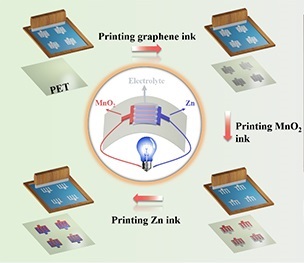
Fabrication of printed Zn//MnO2 planar MBs. (Image by WANG Xiao and HOU Xiaocheng)
In this work, thixotropic ink was firstly configured with manganese dioxide, zinc powder and graphene as active materials, to produce the positive, negative electrodes and the current collector of Zn//MnO2 batteries, respectively. Then, multi-step screen printing method was adopted to realize the simple and low-cost preparation of planar Zn//MnO2 micro-batteries.
The researchers found that the prepared Zn//MnO2 batteries showed not only environmental friendliness and high safety but also exceptional durability, with a capacity of 83.9% for 1300 cycles at current density of 5 C, and good mechanical flexibility and performance uniformity.
In addition, the variety of printing substrates could meet the needs of different application scenarios. As screen printing is a mature technology in industry, this work would be highly promising for cost-efficient and large-scale preparation of planar Zn//MnO2 batteries, and offered new insights for the development of other planar flexible energy storage devices, and the research and application of graphene.
Subscribe
Stay ahead of the technologies shaping the future of electronics with our latest newsletter, Advanced Electronics Packaging Digest. Get expert insights on advanced packaging, materials, and system-level innovation, delivered straight to your inbox.
Subscribe now to stay informed, competitive, and connected.
Suggested Items
Learning with Leo: Drones—Meeting Demand Without Compromise
05/06/2026 | Leo Lambert -- Column: Learning With LeoWith drones used in a wide range of applications today, particularly in modern military conflicts, domestic manufacturers are feeling pressure to produce at high volume and low cost, particularly within an NDAA supply chain ecosystem with differing needs and expectations. Two issues must be considered. First is the manufacturers’ and customers’ need for quality, reliability, and functionality of the product. Second is the manufacturing volume needed to support demand, whether for military, industrial, or commercial applications. Each segment requires verification that the product meets the customer's requirements.
Global Sourcing Spotlight: The True Cost of Low Cost
03/25/2026 | Bob Duke -- Column: Global Sourcing SpotlightThere’s an illusion in global sourcing that cheaper means better business. For decades, procurement teams received rewards for driving down unit prices, without realizing how many zeros those “savings” add to the other side of the ledger. With today’s volatile, interconnected supply chains, the lowest price is rarely the lowest cost.
From PEDC to APEX: Banyan.eco’s Disruptive AI for EMS and OEM Companies
03/17/2026 | Marcy LaRont, I-Connect007The electronics industry’s struggle with supply chain resilience and increasing regulatory complexity has created a costly compliance challenge for OEMs and EMS providers alike. At the same time, advances in artificial intelligence are opening new possibilities for automating some of the industry’s most data-intensive tasks. At the Pan-European Design Conference (PEDC), Banyan.eco cofounder Francis D’Souza introduced a new approach that combines AI-driven data acquisition with a deterministic verification layer to eliminate compliance risk from AI hallucination and dramatically improve productivity.
Fresh PCB Concepts: Cost Stability in a Period of Copper and Gold Volatility
02/12/2026 | Team NCAB -- Column: Fresh PCB ConceptsAnyone who works with PCBs in any capacity right now can feel that copper and laminate prices are not stagnant, gold price is increasing even faster, and the impact shows up quickly on PCB quotations. For many design teams, this feels like a force outside their control. Raw materials go up, and the board cost goes with it. I want to highlight that many of these swings are manageable.
Global Sourcing Spotlight: The New Landscape of Manufacturing
02/11/2026 | Bob Duke -- Column: Global Sourcing SpotlightFor decades, manufacturing followed a familiar pattern: design in the West, production in China, and distribution elsewhere. That map no longer works. The shocks of the past five years—the pandemic shutdowns, trade wars, logistics meltdowns, and geopolitical uncertainty—have redrawn the boundaries of global manufacturing. The question every OEM is asking isn’t “How cheap can we make it”? but “How certain are we that we can obtain it?” We are witnessing a seismic shift in the landscape of making things. The work hasn’t disappeared; it’s just moving.