















 American Made Advocacy: PCBs in the National Spotlight
 Defense Speak Interpreted: Extreme Financial Disparity in Drones and Missiles
 The Right Approach: The End of an Era—DoD Proposes MIL-PRF-31032 Cancellation





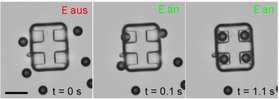
In the future, designers of micromachines can utilize a new effect. A team led by researchers from the Max Planck Institute for Intelligent Systems in Stuttgart have presented a concept that enables the components of microvehicles, microrotors and micropumps to assemble themselves in an electric field. The new concept may help to construct medical microrobots for use in the human body or to fit laboratory devices on a microchip.
Image Caption: Wheel mounting in seconds: as soon as a non-uniform electric field is switched on, the chassis of a microvehicle pulls its own wheels into wheel pockets. After just over a second, all the wheels are in place.
Approximately half the thickness of a human hair, microvehicles could in the future deliver drugs directly to the source of disease, help with diagnosis and take minimally invasive surgery to the next level. However, miniaturization is also of interest for medical, biological and chemical laboratories. With a laboratory on a microchip, medical or environmental chemistry analyses that currently require a room full of equipment could also be performed on the move.
Researchers have long relied on methods to build tiny machines that rely on components finding each other: magnetic particles that come together in a magnetic field, for example, or components that dock to each other thanks to chemical reactions. They now have an additional principle for self-assembly of micro-machines in their toolbox. Scientists working under Metin Sitti, Director at the Max Planck Institute for Intelligent Systems, achieve this using "dielectrophoresis". This involves an electric field of varying strength polarising an electrically insulating plastic frame along with further plastic or quartz glass components. The polarized components, in turn, modify the non-uniform electric field. This is dependent on their shape and can be theoretically modelled by a computer. "If we change the shape of the components, we can control how the components attract each other," explains Yunus Alapan, who was instrumental in developing the concept. By carefully designing the components, a field is formed in which the parts position themselves precisely alongside each other as required for the construction.
Image Caption: For a microvehicle to be able to mount its own wheels, its chassis must be designed so that a non-uniform field will cause them to be pulled towards the wheel bags. A computer can calculate how the component influences the electric field.
The technique allowed the researchers to design a microvehicle with a non-magnetic chassis and magnetic beads as wheels. "We designed the chassis with wheel pockets because, structurally, this generates forces that are ideal for attracting the magnetic wheels," says Alapan. "Only seconds after we turned on the electric field, the wheels were pulled into the wheel bags."
For the vehicle to drive, the wheels need to be able to freely rotate. And this is precisely one of the advantages of the approach pursued by the Stuttgart researchers. "The components of our micromachines are not tightly bound," says Berk Yigit, who was involved in the research for his doctorate. "Rather than forming rigid connections, each part can move independently." The researchers were, therefore, able to drive the microvehicle using a rotating magnetic field that, likewise, rotated the wheels.
Image Caption: As the microparticles that serve as the vehicle's wheels are magnetic, the vehicle can be propelled by a rotating magnetic field.
Utilising the concept of dielectrophoretic self-assembly, the scientists from Stuttgart were able to assemble many other types of micromachines, including a micropump that could be deployed in a laboratory on a chip. They also designed machines that assemble themselves from several larger and smaller components into a more complex structure. And, using the electric field, they repositioned a microsphere, to form a type of miniaturized bumper car. In one position they could propel the vehicle, while in two others they could turn it to the left or right. "Micromachines that have a high degree of mobility could in the future be used to deliver drugs to manipulate individual cells—currently, constructing machines of this size is a huge challenge," says Metin Sitti. "Our new approach has the potential to reduce the complexity of such construction."


