













 It’s Only Common Sense: Win the Sale Before the RFQ Arrives
 The Marketing Minute: Marketing Is a Team Sport





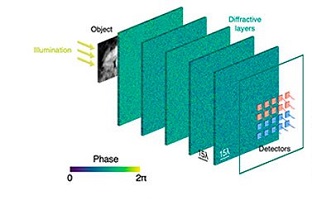
A new paper in Advanced Photonics, an open-access journal co-published by SPIE, the international society for optics and photonics, and Chinese Laser Press (CLP), demonstrates distinct improvements to the inference and generalization performance of diffractive optical neural networks.
One of the key improvements discussed in the paper, "Class-specific differential detection in diffractive optical neural networks improves inference accuracy," incorporates a differential detection scheme combined with a set of parallel-operating diffractive optical networks, where each individual network of this set is specialized to specifically recognize a sub-group of object classes.
According to SPIE Fellow Aydogan Ozcan of the University of California, Los Angeles, and one of the paper's authors, these results "provide a major advancement to bring optical neural network-based low-power and low-latency solutions for various machine-learning applications."
This latest research is a significant advance to Ozcan's optical machine-learning framework: the finessing of this technology is especially significant for recognizing target objects more quickly and with significantly less power than standard computer-based machine learning systems. Ultimately, it may provide major advantages for autonomous vehicles, robotics and various defense-related applications, among others.
These latest systematic advances, in diffractive optical network designs in particular, have the potential to advance the development of next-generation, task-specific, and intelligent computational camera systems.The article authors are Jingxi Li, Deniz Mengu, Yi Luo, Yair Rivenson, and Aydogan Ozcan, of the University of California at Los Angeles Department of Electrical and Computer Engineering, and California NanoSystems Institute in Los Angeles, California, USA.
Advanced Photonics, an open-access journal, is published digitally by SPIE and CLP in the SPIE Digital Library. Its Co-Editors-in-Chief are Xiao-Cong (Larry) Yuan, Shenzhen University, China, and Anatoly Zayats, King's College London, United Kingdom. The SPIE Digital Library contains more than 500,000 publications from SPIE journals, proceedings, and books, with approximately 18,000 new research papers added each year.
About SPIE
SPIE is the international society for optics and photonics, an educational not-for-profit organization founded in 1955 to advance light-based science, engineering, and technology. The Society serves 257,000 constituents from 173 countries, offering conferences and their published proceedings, continuing education, books, journals, and the SPIE Digital Library. In 2018, SPIE provided more than $4 million in community support including scholarships and awards, outreach and advocacy programs, travel grants, public policy, and educational resources. www.spie.org.


