













 It’s Only Common Sense: Win the Sale Before the RFQ Arrives
 The Marketing Minute: Marketing Is a Team Sport





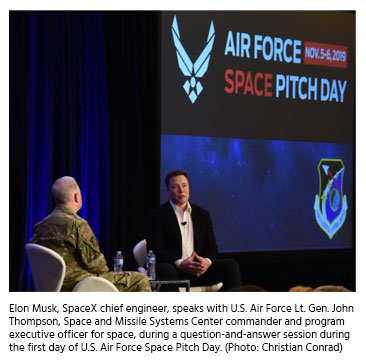
The United States Air Force has long been a leader in space and a catalyst for cutting-edge technology.
But the Air Force doesn’t get there—or stay there—alone, which is why senior officers and officials, including Secretary of the Air Force Barbara Barrett, were in San Francisco Nov. 5-6 for Space Pitch Day, an event designed to find new partners, innovative technologies and products while fast-tracking development.
By the end of the two-day event, 30 pre-selected companies were awarded on-the-spot contracts with the Air Force worth a total of $22.5 million.
“We have to ‘flip the script’ on how we buy things in order to remain competitive with our adversaries and that’s what Air Force Space Pitch Day does,” said Lt. Gen. John F. Thompson, commander, Space and Missile Systems Center, Air Force Space Command and program executive officer for space, the event’s host.
“Space Pitch Day allowed us to seed strategic investment in potentially game-changing capability,” Thompson said. “It demonstrated new ways to inform Air Force strategic investments, accelerate new technology and rapidly acquire capability for our warfighter.”
As in previous Pitch Day events, the Air Force came to San Francisco with a government credit card and a desire to sign on-the-spot contracts and provide same-day payments. The event featured a two-tier reward structure, with successful companies initially eligible for contracts up to $750,000.
This version of Pitch Day also had a new feature in which some of the companies were selected to compete for more lucrative contracts.
The San Francisco event focused on finding products and technologies connected to specific goals, including:
• Early missile detection and warning
• Space situational awareness
• Space communications
• Space visualization
• Multi-domain command and control
• Data mining
• Operations within electronically contested environments
• Artificial intelligence
• Responsive launch systems
• Space logistics
• Protection of critical space assets
The event marked another example of the Air Force’s new push for reforming the way products and services are identified and bought. Supporters insist the effort is reshaping the traditional and often hidebound defense industrial complex by bringing in new partners and innovations.
“Space Pitch Day demonstrates the Air Force’s willingness and ability to work with non-traditional startups and our determination for going faster and smarter,” said Will Roper, assistant secretary of the Air Force for acquisition, technology and logistics.
“It’s not just a tagline; it’s a dead-serious business about keeping the Air Force competitive and dominant,” Roper said.
Pitch Days are a combination of product expo and reality series where the most promising developers are selected from an initial review. That group then pitches their ideas live to a team of Air Force experts and defense partners for an opportunity to compete for on-the-spot contracts.
The exercise is part of a transformation within the Air Force to move faster and find technologies and tools in places that have not been identified. The process streamlines the Air Force’s sprawling and, at times, bulky contracting process.
The goal is to break free from the traditional paper-heavy, bureaucratic process for assessing products and signing contracts. Instead, the Air Force aims to take better advantage of existing commercial expertise and technologies while also serving as a catalyst for innovation and partnership with companies based in the United States.
In keeping with on-the-spot contracts and payments, companies selected at the Space Pitch Day event are expected to produce prototypes within two years.
While relatively new, the Air Force has moved aggressively to expand Pitch Day events and results. The first Pitch Day, held in March 2019 in New York City, resulted in 51 companies being awarded contracts worth up to $158,000 each.
Nine additional Pitch Days are planned.