






First Deep Space Biology Experiment Begins, Follow Along in Real-Time
December 16, 2022 | NASAEstimated reading time: 2 minutes
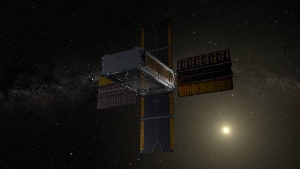
NASA’s BioSentinel has carried living organisms farther from Earth than ever before – more than one million miles. Aboard the shoebox-sized CubeSat are microorganisms, in the form of yeast – the very same yeast that makes bread rise and beer brew. On Dec. 5, BioSentinel was 655,730 miles from Earth when the BioSentinel team at NASA’s Ames Research Center in California’s Silicon Valley sent commands to the spacecraft to kick off the initial experiment for the first long-duration biology study in deep space. Scientists are now able to see how living organisms respond to deep space radiation.
Artemis missions at the Moon will prepare humans to travel on increasingly farther and longer-duration missions to destinations like Mars. Because yeast cells have similar biological mechanisms to human cells, including DNA damage and repair, studying yeast in space will help us better understand the risks of space radiation to humans and other biological organisms. BioSentinel’s science results will fill critical gaps in knowledge about the health risks in deep space posed by space radiation.
BioSentinel – which launched aboard Artemis I – is orbiting the Sun, positioned beyond Earth’s protective magnetic field. There, the CubeSat will run a series of experiments over the next five to six months.
NASA invites the public to virtually ride along with BioSentinel’s deep space journey using NASA’s “Eyes on the Solar System” visualization tool, a digital model of the solar system. This real-time simulated view of our solar system runs on real data. The positions of the planets, moons, and spacecraft – including BioSentinel – are shown where they are right now.
You can adjust the level of illumination on the spacecraft by clicking on the show/hide settings button in the bottom right of the screen. Once opened, you can toggle between flood, shadow, and natural lighting. Additionally, you can use time controls – at the bottom of the screen – to fast-forward or rewind time in the simulated view, to preview BioSentinel’s future trajectory or see a recap of its prior path.
Subscribe
Stay ahead of the technologies shaping the future of electronics with our latest newsletter, Advanced Electronics Packaging Digest. Get expert insights on advanced packaging, materials, and system-level innovation, delivered straight to your inbox.
Subscribe now to stay informed, competitive, and connected.
Suggested Items
Kymeta Joins Red Cat Initiative for Maritime Connectivity
05/15/2026 | Globe NewswireRed Cat Holdings, Inc. , a U.S.-based provider of advanced all-domain drone and robotic solutions for defense and national security, announced that Kymeta, a world-leading flat-panel satellite terminal manufacturer, has joined the Red Cat Futures Initiative, the company’s industry-wide consortium accelerating advanced autonomous systems for modern warfare.
SPARK Microsystems Selected for CAD $1M in Government of Canada-backed FABrIC Funding
05/14/2026 | BUSINESS WIRESPARK Microsystems, a Canadian fabless semiconductor company specializing in next-generation short-range wireless communications, has been selected by FABrIC as a CAD $1 million grant recipient funded by the Government of Canada.
System Architecture Beyond the Die With Advanced Packaging as the Scaling Factor
05/14/2026 | Chetan Arvind Patil, Marvell TechnologyIn conventional monolithic semiconductor design, system integration was achieved within a single die and constrained by reticle limits. Compute cores, cache, memory controllers, and input output (I/O) interfaces were all co-optimized on a single process node, with performance closely tied to transistor density and on-die interconnect efficiency. This monolithic system-on-chip (SoC) approach enabled low-latency communication and relatively straightforward power delivery. However, as design for compute-intensive SoCs approaches reticle limits and advanced-node costs increase, the ability to continue scaling within a single die begins to diminish.
Rethinking Reinforcement Materials for Advanced Packaging
05/14/2026 | Ivana Ivanovic, Flexiramics B.V.Materials that once quietly supported the industry are now becoming limiting factors. The electronics industry is experiencing unprecedented pressure as RF systems push into mmWave frequencies, high-speed digital architectures advance into their next performance generation, and power densities climb across automotive, telecom, aerospace, and computing. Reinforcement materials, long treated as a background detail in laminate design, are suddenly at the centre of performance, reliability, and supply‑chain discussions.
Below the Surface: Active Component and Module Submounts—The Architecture Behind Performance
05/14/2026 | Chandra Gupta -- Column: Below the SurfaceIf you were to peel back the layers of a modern electronic system, such as a satellite transceiver, a LiDAR module, or a 5G base station, you would not immediately notice a specific component doing some of the most important work. It doesn’t amplify signals, emit light, or process data, yet without it, none of those functions would be stable, reliable, or scalable. That component is the active device submount.