














 American Made Advocacy: American PCBs in Big Demand and Short Supply
 Defense Speak Interpreted: Will Defense Become a Totally New Supplier for Drone Electronics?
 The Right Approach: The End of an Era—DoD Proposes MIL-PRF-31032 Cancellation





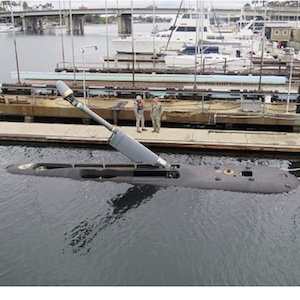
Boeing has delivered the first Orca Extra Large Uncrewed Undersea Vehicle (XLUUV) to the U.S Navy following acceptance testing completion this month. The XLUUV, designated by the Navy as “Orca,” is a new class of autonomous submarine that can perform long duration critical missions to achieve undersea maritime dominance in changing environments and contested waters.
“This is the culmination of more than a decade of pioneering work, developing a long-range, fully autonomous undersea vehicle with a large payload capacity that can operate completely independently of a host vehicle,” said Ann Stevens, Boeing Maritime and Intelligence Systems vice president. “I’ve had the distinct pleasure of witnessing our team bring this first-of-its-kind capability to life, and I’m proud of their innovation, perseverance and unwavering commitment which has yielded the most advanced and capable UUV in the world. With the Navy’s partnership, we look forward to continuing to deliver this game-changing vehicle to the fleet.”
With the partnership of the Navy, Orca has undergone several phases of at-sea testing, including above and below surface maneuvers to demonstrate the vehicles’ unique capabilities.
Orca is the result of more than 50 years of Boeing experience building and operating undersea vehicles. In 2012 Boeing initiated the design and development of Echo Voyager, a proof-of-concept XLUUV that began at-sea testing in 2017 and was a precursor to the US Navy’s Orca XLUUV competition. Echo Voyager – the world’s only vehicle of its size and capability – has spent over 10,000 hours operating at sea and transited hundreds of nautical miles autonomously.


