















 Learning With Leo: UHDI—The Next Leap in PCB Manufacturing
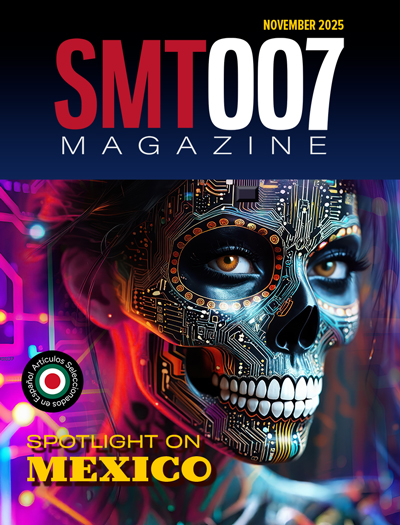
 Nolan’s Notes: Is Mexico the Pulse of Electronics in the Americas?
 Standard of Excellence: Speed vs. Quality in Customer Service





Where Is the China Business Going?
June 19, 2024 | Nolan Johnson, SMT007 MagazineEstimated reading time: 2 minutes

We met with Milwaukee Electronics’ CEO Jered Stoehr and Vice President of Sales Paul Forker to discuss the evolving dynamics of Mexico's role in global trade, particularly in comparison to China. The recent increase in trade with Mexico, due to the impact of tariffs on business opportunities, and the shift of some companies from China to Mexico stemming from factors like cost competitiveness and geopolitical risks, have been key to Mexico’s position as the number one trade partner with the U.S. The conversation also delves into the importance of workforce skills, company culture, and decision-making autonomy in selecting a Mexico-based EMS provider.
Nolan Johnson: A recent headline read, “Is Mexico the Next China?” How true is this for Milwaukee Electronics?
Jered Stoehr: We've been in Mexico since the 1990s, longer than many other CMs. We have two domestic facilities in the U.S. and one in Mexico. Our Mexico customer base has historically been higher volume, but there wasn't a huge gap in the size of the customer with our U.S. facilities back then. More recently, when the tariffs were implemented, things changed significantly. Our Mexico facility is attracting larger customers and opportunities today. It has grown relative to our domestic facilities.
In fact, I have a publicly available report from Deloitte about Mexico. It says U.S. trade has been growing significantly with China and Mexico for a long time. From 2010 to 2019, the trade gap between China and Mexico stayed consistent even as trade increased. There’s a dip in 2020 due to COVID, but then a correction and a return growth for both. From 2022 to 2023, though, a big gap opens, with China declining and Mexico continuing to grow.
Johnson: Is this the first time you see the two countries diverge?
Stoehr: Yes. That macro-level view shows the shift. In our experience, when the tariffs were implemented, we started seeing significant increases in large-quantity opportunities for our Mexico facility. Ten or 15 years ago, a large EMS customer had either already gone to Asia or was headed there. In these past several years, a significant number of those customers have shown interest in Mexico.
Paul Forker: There clearly has been an increase in demand for our quoting opportunities with customers or prospects who have been in China. China used to be an automatic choice; now, newer companies with a product hitting its stride in production aren’t considering China like they once were.
Johnson: Paul, does this business constitute existing work coming from China, or are these new products with which they've decided to start production in Mexico?
Continue reading the rest of this interview in the June 2024 issue of SMT007 Magazine.
Share on:


Testimonial
"We’re proud to call I-Connect007 a trusted partner. Their innovative approach and industry insight made our podcast collaboration a success by connecting us with the right audience and delivering real results."
Julia McCaffrey - NCAB GroupSuggested Items
Zayo Puts High-Capacity Network Muscle Behind Mexico, U.S. Manufacturing Corridor
11/10/2025 | BUSINESS WIREZayo, a leading global communications infrastructure provider, announced the launch of its first Zayo-owned Point of Presence (PoP) in Mexico, a major expansion of Zayo’s high-capacity North American network.
Nolan’s Notes: Is Mexico the Pulse of Electronics in the Americas?
11/04/2025 | Nolan Johnson -- Column: Nolan's NotesLast year, I attended SMTA Guadalajara, where I saw the results of the Mexican investment in electronics manufacturing. The U.S. was still operating under the Biden administration, and while Mexican EMS companies had expanded capacity to support EV manufacturing, the demand dropped significantly. In my conversations at the show, the sentiment was one of patience. They knew the EV business would likely come back. However, they didn’t expect an overhaul of U.S. trade agreements and tariffs that would shift a more diversified portfolio in Mexico’s direction.
SMT007 Magazine November 2025: Inside Mexico’s Rise as an Electronics Manufacturing Leader
11/04/2025 | I-Connect007 Editorial TeamMexico isn’t just part of the electronics manufacturing conversation—it’s leading it. From growing investments to cross-border collaborations, Mexico is fast becoming the center of electronics in North America. In this issue, we uncover why Mexico is earning global recognition. From top-ranked manufacturing capabilities to expanding partnerships that reach far beyond the U.S.
I-Connect007 Editor’s Choice: Five Must-Reads for the Week
10/31/2025 | Nolan Johnson, I-Connect007Last week, the IMPACT conference took place in Taipei, bringing together advanced packaging experts from around the globe to share their knowledge. We’ll be bringing you post-conference coverage over the next few weeks, so look for that in our newsletters, and in the Advanced Electronic Packaging Digest. Other news seemed to have the U.S. at the center of the global discussions. My picks start in Phoenix, where TSMC, NVIDIA, and Amkor are all scrambling to establish new capabilities. There’s nothing like a strong demand signal to cause build-out, and AI chips are doing exactly that.
Electronics Industry Warns Mexico Tariffs Could Undercut U.S. Manufacturing and Supply Chain Resilience
10/24/2025 | Global Electronics AssociationAs negotiations over U.S.–Mexico trade policies near an October 29 deadline, the Global Electronics Association released a new policy brief, From Risk to Resilience: Why Mexico Matters to U.S. Manufacturing.