














-
- News
- Books
Featured Books
- I-Connect007 Magazine
Latest Issues
Current Issue
Signal Integrity & Metallization
Signal integrity and additive manufacturing, particularly metallization, are hot topics in PCB design and fabrication. PCB layouts are carefully engineered to achieve specific electrical and power performance targets.
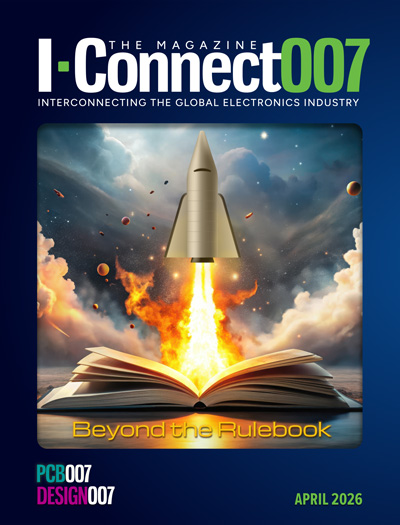
Beyond the Rulebook
What happens when the rule book is no longer useful, or worse, was never written in the first place? In today’s fast-moving electronics landscape, we’re increasingly asked to design and build what has no precedent, no proven path, and no tidy checklist to follow. This is where “Design for Invention” begins.
March Madness
From the growing role of AI in design tools to the challenge of managing cumulative tolerances, these articles in this issue examine the technical details, design choices, and manufacturing considerations that determine whether a board works as intended.
- Articles
- Columns
- Links
- Media kit
||| MENU - I-Connect007 Magazine
Laser Photonics, Boston Engineering Announce Partnership to Equip Naval Robotic Crawler with Laser Technology
August 13, 2024 | BUSINESS WIREEstimated reading time: 2 minutes
Laser Photonics Corporation (LPC), a leading global developer of industrial laser systems for laser cleaning and other material processing applications, and Boston Engineering Corporation, a product design and engineering consulting company, announced that they have formed a partnership to integrate laser technologies into autonomous robots for use in the naval defense industry.
Boston Engineering specializes in developing unmanned vehicles that can autonomously perform tasks previously done by humans. This has resulted in the company creating systems that help complete operational tasks in the maritime industry faster and more precisely. Boston Engineering has also created technologies that protect people from injury and, in many cases, extend detection, inspection and repair capabilities. Now, Boston Engineering has selected LPC as its technology partner to provide advanced laser tools for integration into its robotic crawler technology.
“Laser Photonics enters this partnership with Boston Engineering with great enthusiasm, eager to combine the power of autonomous robots and laser technology,” said Wayne Tupuola, CEO of LPC. “We are ready to revolutionize the way naval drydock and related maintenance operations are performed, helping address the challenges of labor shortages and safety concerns in situations where fast fleet turnaround is critical.”
Boston Engineering will incorporate LPC’s cutting-edge laser technologies into its robotic crawler, which will then be able to scale ship hulls and other structures to automate corrosion removal, contamination cleaning, and other material processing tasks safely and effectively. This includes effectively operating in hard-to-reach and dangerous areas.
Mark Smithers, CTO and co-founder of Boston Engineering, said: “There’s a big push in the naval defense space for automation. The addition of LPC technology to our robotic crawler gives us another potent asset in our arsenal. Laser cleaning is highly time- and labor-efficient for optimizing maintenance and repair. We look forward to equipping our crawler with laser power through this partnership.”
Integrating these two technologies together will lead to a definitive solution for professionals in the defense, maritime, shipbuilding and boat maintenance/repair industries who are looking for a viable and safe method of effectively addressing surface preparation, cleaning, decontamination and restoration.
Testimonial
"In a year when every marketing dollar mattered, I chose to keep I-Connect007 in our 2025 plan. Their commitment to high-quality, insightful content aligns with Koh Young’s values and helps readers navigate a changing industry. "
Brent Fischthal - Koh YoungSuggested Items
LPKF Gets Off to a Solid Start in 2026
05/04/2026 | LPKFLPKF Laser & Electronics SE has made a solid start to the 2026 financial year despite a macroeconomic environment that remains challenging.
Driving Innovation: Selecting the Right Laser Source
04/28/2026 | Simon Khesin -- Column: Driving InnovationWhen I first joined Schmoll Maschinen, I brought experience from almost every PCB process, except for laser. As I immersed myself in laser processing, I realized why it can seem so daunting to a newcomer. The complexity arises from three intersecting factors: A vast variety of laser sources: CO2, UV-nano, green-pico, UV-pico, IR-pico, and others; a diverse range of applications: Drilling, cutting, ablation, and more; and an extensive list of materials: These have vastly different absorption rates. Choosing the right machine or laser source is rarely trivial. Even for experienced engineers, answering "Which source is best?" requires examining the business's specific goals.
AI, HDI, and Interconnect Optimization with MKS' ESI
04/23/2026 | Real Time with... APEX EXPOThis discussion revolves around the transformative impact of AI on HDI and substrate manufacturing. Casey Krueger explains the company's "Optimize the Interconnect" initiative, which features Atotech, to provide a comprehensive solution from pretreatment to laser drilling. MKS' ESI offers the innovative Geode G2 platform which is an advanced laser drilling technology that enhances productivity, reduces energy consumption, and addresses complex design challenges in processing both PCB and ICP materials.
Horizon Sales Adds LPKF Laser and Electronics to Its Lineup
04/21/2026 | Horizon SalesHorizon Sales, a leading manufacturers’ representative and distributor to the electronics industry, is pleased to announce a new partnership with LPKF Laser and Electronics, a global leader in precision laser technology
Future-proof Laser Depaneling for PCBs with Photonics
04/10/2026 | Real Time with... APEX EXPOBill Solari of Photonics Systems USA outlines the advantages of laser depaneling for circuit board manufacturing. We learn that this advanced technology addresses rising material costs by increasing panel yield and improving edge quality. This process provides precision, suitability for medical applications, and cost-saving benefits, including the elimination of cleaning steps. There have been significant advancements in laser depaneling, offering a competitive and efficient solution for modern electronics production.