















 American Made Advocacy: While Congress Debates, America’s PCB Competitors Invest Billions
 Defense Speak Interpreted: The Impact of Venture Capital-backed Defense Contractor Firms





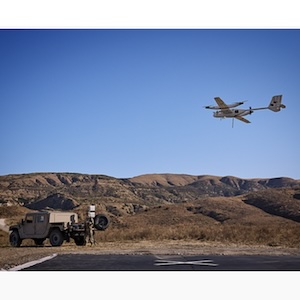
AeroVironment (AV) has introduced the P550™ advanced autonomous Group 2 eVTOL uncrewed aircraft system (UAS) designed to set a new standard for battlefield adaptability and operational readiness. Leveraging a Modular Open Systems Approach (MOSA) and AI-driven autonomy, P550 is engineered to empower maneuver forces to quickly respond to evolving mission demands with rapid deployment, scalability, and superior situational awareness.
Unveiled at the Association of the United States Army’s (AUSA) Annual Meeting, the P550’s all-electric powertrain provides flight endurance of over 5 hours and a multi-sensor payload capacity of up to 15 pounds. This endurance and payload capability deliver critical intelligence gathering, precision targeting, and force protection in dynamic and contested environments.
"Warfighters today require systems that can quickly adapt to fluid combat scenarios, providing unmatched reliability and flexibility,” said Trace Stevenson, AV’s senior vice president and general manager of Uncrewed Systems. “P550 meets these needs through an adaptable, field-reconfigurable design that allows rapid, on-the-fly adjustments for evolving operational requirements.”
At the core of P550 is its MOSA framework, enabling seamless integration with third-party payloads, datalinks, ground control systems, and mission software. This open and scalable architecture not only future-proofs the UAS for continuous upgrades but also keeps pace with technological advancements at low cost and risk. P550's standard interfaces allow interoperability with multiple ground control systems providing operators with mission flexibility and compatibility across various platforms.
Purpose-built for rapid deployment in any environment, P550’s modular design features toolless airframe assembly with hot-swappable batteries and multi-sensor payloads ensuring maximum operational readiness. For enhanced lethality, the UAS supports a range of offensive capabilities, including laser designation, sensor-to-shooter functionalities, and proven munitions. Its modular communication architecture further boosts operational resilience by offering flexible datalink options, maintaining reliable performance even in complex, contested environments.
P550 integrates AV’s SPOTR-Edge™ Automatic Target Recognition (ATR) and AVACORE™ software suite for onboard edge computing. These advanced AI capabilities enable the UAS to autonomously detect and classify operationally relevant objects—ranging from personnel and vehicles to aircraft and maritime vessels—day or night, ultimately enhancing situational awareness and tactical decision-making on the battlefield.
Building on AV’s three-decade legacy of delivering reliable, combat-proven UAS, P550 demonstrates a continued commitment to providing intelligent, autonomous platforms that ensure operational superiority. The system’s modular, future-ready architecture allows for continuous evolution, meeting the demands of today’s battlefields while remaining prepared for the challenges of tomorrow.


