














 It’s Only Common Sense: Win the Sale Before the RFQ Arrives
 The Marketing Minute: Marketing Is a Team Sport





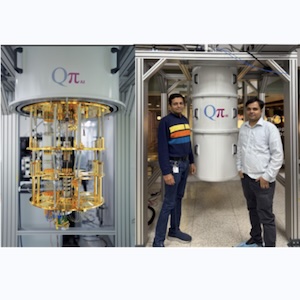
QpiAI, a leader in quantum computing and generative AI, announced its First Quantum computer launch code named QpiAI Indus Quantum Computer.
Dr Nagendra Nagaraja, CEO and Founder of QpiAI, said, "We are excited about our roadmap to commercialize quantum computers, leveraging large-scale qubit integration and logical qubits. The T1 and T2 times for our current 25-Qubit Indus Quantum Computer are 30 μs and 25 μs, respectively, characterized by our in-house developed quantum control electronics cluster, and are expected to increase to 100 μs soon. Furthermore, with our patented qubit architecture, we expect to reach a T1 time of 1 ms in early 2026. With single-qubit gate fidelity of 99.7% and two-qubit gate fidelity of 96%, supporting all native gate sets, our system is interfaced with QpiAI quantum software SDKs for application development. We will soon be expanding to 64-qubit quantum computers. We will have rich partnerships with fellow component suppliers, large pharma and chemical companies, data center players, and hyperscalers to commercialize quantum computing. Our key IP lies in using an AI-based agentic system to manufacture qubits and fine-tune them to obtain desired fidelity, error correction, and noise levels, where the Agentic AI system in our datacenter works in a closed loop with the quantum computer."
QpiAI Quantum and AI Full-Stack Vertical Integration
QpiAI has developed full-stack quantum computing technology vertically integrating AI and Quantum computing systems combining AI, quantum computers, algorithms, software, and applications. The Gen-1 QpiAI system is built with efficient Quantum-HPC integration with a colocated HPC datacenter for high-throughput and low-latency computing. The QpiAI quantum applications stack combines AI-driven quantum compilation with application-specific architectures for maximizing hybrid quantum-classical performance. QpiAI Quantum software platforms and products, including QpiAI-Logistics, QpiAI-Opt, QpiAI-ML, QpiAI-Pharma, and QpiAI-Matter, are targeted for core quantum applications in logistics, finance, material discovery, and pharma industries.
QpiAI Quantum QPU Technology
QpiAI quantum computers use superconducting qubits and roadmap to experiment with CMOS-based spin qubits in future models. The current generation of qubits is based on various architectures of superconducting qubits design. QpiAI NISQ (Noisy Intermediate-Scale Quantum) qubits and QpiAI FTQC (Fault-tolerant Quantum Computing) qubits are based on QpiAI proprietary qubit architecture named QpiAI Qubits. Transmon qubits are stabilized and error-corrected based on the surface codes with various distances. For higher reliability in fault-tolerant computing, QpiAI FTQC Qubits are error-corrected using Q-LDPC codes with new architectures invented by QpiAI to ensure high performance and low error rates.
Quantum computing today faces limited scalability and reliability challenges due to errors from decoherence, noise, and gate inaccuracies, impacting readiness for industrial applications. To address these, QpiAI is advancing error mitigation on NISQ devices with built-in Surface code schemes, and implementing Q-LDPC codes within our fault-tolerant roadmap. We aim to create scalable, reliable quantum systems capable of supporting complex, high-impact applications.
AI Technology
QpiAI has built advanced next generation generative AI and agentic AI systems that can autonomously navigate complex scenarios and build emergent intelligence through agent-based modeling. Our optimized data-to-intelligence stack and high-performance infrastructure enables modeling and automation at unprecedented scales, while ensuring a seamless transition to quantum-based modeling in the future with the optimal combination of bits, qubits, and neurons.


