













 American Made Advocacy: While Congress Debates, America’s PCB Competitors Invest Billions
 Defense Speak Interpreted: The Impact of Venture Capital-backed Defense Contractor Firms





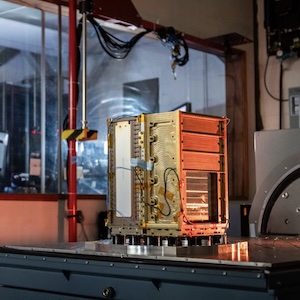
The small satellites passed a crucible of tests, ending with a simulation of the intense vibrations of launch.
When the six tiny spacecraft of NASA’s SunRISE (Sun Radio Interferometer Space Experiment) mission settle into their orbits high above Earth after launching later this year, they’ll function as one giant radio dish to track the rumbles of radio bursts coming from deep within the Sun’s atmosphere, or corona. Those bursts are generated by solar energetic particle events that could in extreme cases irradiate unprotected astronauts and satellites; tracking the radio waves they generate with SunRISE will help scientists mitigate their effects.
To ensure these six toaster-oven-size spacecraft operate as designed for their one-year prime mission, they underwent a rigorous campaign of testing at Utah State University’s Space Dynamics Laboratory in Logan, Utah, where they were built. The campaign included thermal vacuum testing that simulated the environmental conditions in orbit. Electromagnetic compatibility testing made sure that the small satellites’ electronic systems won’t interfere with their sensitive science instruments. Then came vibration testing to make sure nothing breaks, falls off, rattles, or gets damaged during launch.
Launch day vibes
To simulate the kind of vibrations that the SunRISE small satellites (or SmallSats) will experience during launch, the testing team needed to simulate the vibration profile of the mission’s specific ride into space. The profile depends on the type of rocket and payloads it will carry.
“Each spacecraft was loaded with propellant to match launch mass and subjected to vibration testing in all three axes. The objective was to make the simulated vibrations as true to the conditions of launch as possible,” said Jim Lux, SunRISE project manager at NASA’s Jet Propulsion Laboratory in Southern California. “Pre- and post-test functional checks were performed, and all six spacecraft aced them.”
The heliophysics mission will launch from Cape Canaveral Space Force Station in Florida as a rideshare aboard a United Launch Alliance Vulcan Centaur rocket, sponsored by the United States Space Force’s Space Systems Command.
Solar radio bursts
After launch, the SunRISE satellites will be delivered slightly above geosynchronous orbit (about 22,000 miles, or 35,000 kilometers, in altitude) and deploy their four telescoping antenna booms — each about 10 feet (2.5 meters) long — which form an “X.”
The spacecraft will fly in formation up to 10 miles (16 kilometers) apart, creating a single large radio telescope. After the SmallSats communicate via NASA’s Deep Space Network, scientists will use a technique called interferometry to combine the observations, creating a single, large radio telescope. This configuration will enable them to detect solar radio bursts and map the Sun’s magnetic field from the outer corona into interplanetary space.
“Solar radio bursts are triggered after vast quantities of energy stored in the Sun’s magnetic field accelerate solar particles to high speeds,” said Sue Lepri, SunRISE principal investigator at the University of Michigan in Ann Arbor. “Tracking these events will not only help space agencies mitigate their damaging effects on astronauts and spacecraft but will also add new science to our growing knowledge base of how space weather is generated and propagates throughout the solar system.”
The SunRISE mission will complement other NASA heliophysics missions, such as the agency’s Solar TErrestrial RElations Observatory, Parker Solar Probe, and Solar Orbiter, an international cooperative mission between ESA (European Space Agency) and NASA.


