











 Marcy’s Musings: A Frighteningly Good October Issue
 It’s Only Common Sense: Win the Sale Before the RFQ Arrives
 The Marketing Minute: Marketing Is a Team Sport





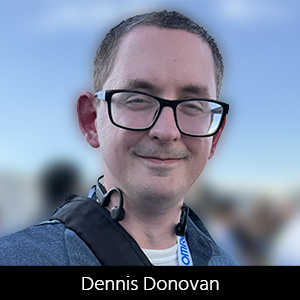
Like many of today’s engineers, Dennis Donovan grew up interested in how things worked. He wanted to see what was inside and how to make it better. Now, he has three bachelor’s degrees, is earning his master’s, and works as an electrical engineering technologist. He aspires to work in PCB assembly with a particular focus on aerospace electronics. He’s a sharp, well-spoken young man with an eye on his future.
Michelle Te: Dennis, tell me about your background and the work you do at Kratos.
Dennis Donovan: I went to school in several places. My first alma mater was Metropolitan State University in Denver. Then I went to Arizona State, and now I go to Colorado School of Mines for my master's in electrical engineering. I should complete my master's this year, and then hopefully I'm finally done with school. It's been a very long time in there.
At Kratos, I work as a manufacturing engineer for radio frequency printed circuit boards, and box builds that go into satellite ground stations.
Te: What first sparked your interest in electronics or engineering?
Donovan: I watched an Air Force Tech take apart his computer when I was six years old, and then that was it. If I saw something, I always wanted to know what was inside, or I wondered how something happened.
Te: You’ve obviously been interested in this type of industry for a long time, but what’s surprised you about electronics manufacturing?
Donovan: How much of learning can involve failure at first. The first time I was involved in the production line, I found out there's a tolerance for how many parts you can lose, like 10-15%. That can depend on whether it's a low-volume product or a high-volume product. But I found that was just an incredible way to learn what you're doing.
You can fail a few times, and it's okay, and then you can continue to just do your build. Whenever I learn something new, I’ll ask myself whether this is a space where I can fail a little bit before I learn how to do it properly. It allows that ramp-up.
Te: You're early in your career, so what kind of impact do you hope to make in the industry?
Donovan: The impact I want to make is I'd like to see space become a little more like how we produce phones, and that we get away from low volume and go to higher volume, figure out how to do modular form factors and how to create more standard performance for how we build everything.
Right now in aerospace, everyone builds a gyro or an engine differently, and each might be technically within the same classification, but the standards are so vague that something that can fit within a 10x10x10 cm box is still the same thing as something that can barely fit within the back of a semi. Those are small stats.
The change I hope to make in the industry is to work on an initiative to see more formalization, more form factors for standard ways in which we do things.
Te: Is that something you would do on your own or as part of a team?
Donovan: They'll likely be a team effort, like a reach across the industry. As I like to think about, Google started the Open Handset Alliance to make sure all phones were the standard rectangular brick that we see. I'd like to see a similar initiative happen in space where we start turning out very standardized products.
Te: Is there a technology or something that excites you right now?
Donovan: The thing that excited me in the last five, six years was the helicopter that landed on Mars back in 2020, because it had the same processor in it that was in my phone back in 2015. So, you saw a space willing to take the risk on commercial off-the-shelf hardware and put it into space products. Even though there was a higher risk than, say, using the 1990s power Pro PC chips that were diamond-hardened and could survive in radiation-hardened environments that went into the rover.
For the helicopter, they decided to just use this commercial product and it worked. It flew for 70 flights. I'd like to see more and more of that happen. That inspires me.
Te: Let’s talk about your involvement in the Emerging Engineers Program. Who is your mentor and how’s that going for you?
Donovan: Oh, it's fantastic. I get to talk to a lot of the older members of the Association and pick their brains about their thoughts and experiences, and what they felt helped shape them as engineers. I get to use them as a resource in my professional work as an engineer.
They're always open when I may reach out, and if there's somebody with knowledge, but I'm not quite sure where it rests, I can ask them, and they'll point that in my direction. It’s an incredible experience and resource.
My mentor is Dr. Bhanu Sood, Chief Technologist at NASA Goddard (and this year’s recipient of the Hall of Fame award). He has been terrific both as an IPC resource for navigating committees and as a source for industry trends to pay attention to. Hearing his perspective on how program-level decisions are made, how requirements are chosen, and how all of this connects back to work I do has been incredibly valuable.
Te: Good for you. Thanks for chatting with me.
Donovan: Thank you very much.


