

















 The Right Approach: Old Philosophies, New Tools
 Trouble in Your Tank: HDI and UHDI—Building the Foundation of Advanced Packaging
 It’s Only Common Sense: Look Beyond the Tariffs





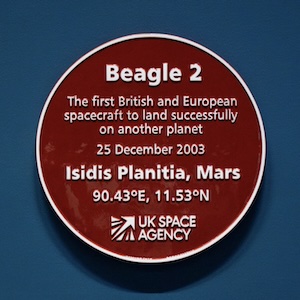
Beagle 2 touched down on Mars on Christmas Day 2003 but fell silent and was presumed lost for over a decade. In January 2015, NASA imagery confirmed it had landed safely and precisely on target — its silence likely caused by a single solar panel failing to fully deploy.
Host sites include the National Space Centre in Leicester, the Science Museum in London, Jodrell Bank in Cheshire, the Open University in Milton Keynes and Airbus in Stevenage, with a family celebration day at the National Space Centre on Sunday 7 June.
A series of commemorative red plaques will tell the story of Beagle 2, the pioneering British spacecraft that, against all odds, made it to the surface of Mars.
Thirteen plaques will be unveiled at organisations and companies that played an integral role in the mission or continue to champion space exploration to the public. The initiative is part of the UK Space Agency’s wider mission to celebrate the UK’s proud history in space exploration and inspire the next generation of scientists, engineers and explorers.
For more than a decade the lander had been presumed lost after no signal was received following landing on Christmas Day 2003.
Then, in January 2015, it was confirmed that Beagle 2 had successfully landed precisely where it was expected to, making it the first British and European spacecraft to land on another planet.
Images from NASA’s Mars Reconnaissance Orbiter revealed the spacecraft had landed safely, with its entry and descent systems performing as designed. The cause of its silence is thought to be a single solar panel that failed to fully deploy, blocking the communications antenna.
Conceived by Professor Colin Pillinger of the Open University, in collaboration with the University of Leicester and a network of UK academics and companies, Beagle 2 was carried to Mars aboard the European Space Agency’s Mars Express mission. The spacecraft was intended to analyse Martian soil and atmosphere for evidence of past life on Mars.


