






 It’s Only Common Sense: Stay Curious, My Friends
 The Marketing Minute: AI Is Watching Your Marketing Habits
 Trouble in Your Tank: The Role of Organic Solderability Preservatives in Advanced Packaging





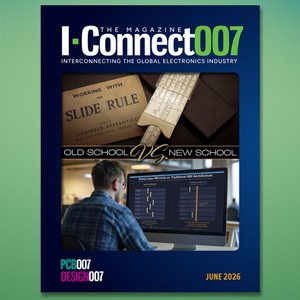
The debate between old school and new school thinking has existed throughout every era of technological advancement. In the June 2026 issue of I-Connect007 Magazine, we examine how that debate is playing out across today's PCB design, fabrication, and manufacturing landscape.
As electronics become faster, denser, and more complex, industry leaders are questioning which traditional practices still serve us well and which are reaching their limits. This issue brings together experts from across the electronics ecosystem to explore where innovation is driving necessary change, and where time-tested engineering principles remain as relevant as ever.
Highlights:
Barry Olney explains why traditional stripline and microstrip geometries are being challenged as data rates advance toward 224G PAM4 and beyond.
Matt Stevenson introduces total value management (TVM), arguing that collaboration, innovation, and long-term partnership have become more valuable than simple cost comparisons when selecting manufacturing partners.
Kristin Moyer explores the evolution from concurrent design to co-design and the benefits of integrated collaboration among electrical, mechanical, RF, and thermal teams.
Vern Solberg continues his examination of advanced packaging technologies and the expanding role PCB designers must play as electronic systems become increasingly integrated.
John Watson always finds a clever way to remind us that while tools and technologies evolve, the fundamental disciplines of good PCB design remain remarkably consistent.
Stephen Chavez considers whether today's PCB design engineer must become a broader systems-focused professional to meet modern development challenges.
The issue also features a special focus on one of the industry's newest technologies: every layer interconnect (ELIC), sometimes called every layer microvia (ELMV). Industry experts, including Anaya Vardya, Ralph Jacobo, and Ed Kelley, examine the opportunities and challenges associated with these advanced high-density interconnect structures, from manufacturing and lamination requirements to material selection and reliability considerations.
Additional articles cover signal integrity, etching processes, insertion loss, surface finishes, advanced packaging, flex PCB design, AI implementation in manufacturing, and legislative developments affecting the PCB industry.
Whether you're embracing new methodologies, defending proven practices, or trying to find the right balance between the two, this issue offers valuable insights into how our industry is building on the foundation that got us here.