











 Dan’s Biz Bookshelf: Four Important Books You Need to Read (Not Just Say You Have)
 The Marketing Minute: Cracking the Code of Technical Marketing





Running Robots to be Discussed at Corvallis Science Pub
September 11, 2015 | OSU College of EngineeringEstimated reading time: 1 minute
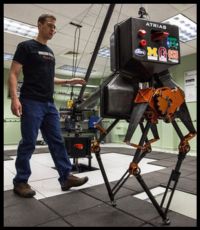
Robots already build cars, perform household chores and explore the oceans, but most of these machines are not ready to walk safely among humans.
At the Sept. 14 Corvallis Science Pub, Oregon State University’s Jonathan Hurst will describe efforts to teach a robot how to walk with dexterity on uneven terrain.
“It’s possible to have robots that walk and run and manipulate things and do all the physical interactions that people can do,” said Hurst, an associate professor of mechanical engineering at Oregon State and a leader of its growing robotics program.
“We have physical proof. I can do it. Why not a robot? Where will it happen first? That’s the question.”
Working with OSU students and with colleagues at the University of Michigan and Carnegie-Mellon, he designed a robot known as ATRIAS, the first machine to reproduce human-like and animal-like ground reaction forces and center-of-mass motion for a bipedal walking gait. The researchers derive inspiration from the locomotion of birds.
The Science Pub presentation is free and open to the public. It begins at 6 p.m. at the Old World Deli, 341 S.W. 2nd St. in Corvallis. Sponsors of Science Pub include Terra magazine at OSU, the Downtown Corvallis Association and the Oregon Museum of Science and Industry.
About the OSU College of Engineering
The OSU College of Engineering is among the nation¹s largest and most productive engineering programs. Since 1999, the college has more than tripled its research expenditures to $37.2 million by emphasizing highly collaborative research that solves global problems. It is a leader in signature research areas, including precision health, clean energy, resilient infrastructure and advanced manufacturing; and targeted strategic areas, including robotics, materials research and clean water.
Share on:


Testimonial
"Advertising in PCB007 Magazine has been a great way to showcase our bare board testers to the right audience. The I-Connect007 team makes the process smooth and professional. We’re proud to be featured in such a trusted publication."
Klaus Koziol - atgSuggested Items
BLT Joins Microchip Partner Program as Design Partner
09/17/2025 | BUSINESS WIREBLT, a U.S.-owned and operated engineering design services firm announced it has joined the Microchip Design Partner Program.
HyRel Technologies Showcases Summer Intern Success Through Hands-On Innovation
09/16/2025 | HyRel TechnologiesHyRel Technologies, a global provider of quick turn semiconductor modification solutions, proudly highlights the accomplishments of its two recent summer interns, Danny Hoang and Nisarg Jadav.
ASM Technologies Limited signs MoU with the Guidance, Government of Tamilnadu to Expand Design-Led Manufacturing capabilities for ESDM
09/15/2025 | ASM TechnologiesASM Technologies Limited, a pioneer in Design- Led Manufacturing in the semiconductor and automotive industries, announced signing of Memorandum of Understanding (MoU) with the Guidance, Government of Tamilnadu whereby it will invest Rs. 250 crores in the state to expand its ESDM related Design-Led Manufacturing and precision engineering capacity. ASM Technologies will acquire 5 acres of land from the Government of Tamilnadu to set up a state-of-the-art design facility in Tamil Nadu's growing technology manufacturing ecosystem, providing a strong strategic advantage and long-term benefits for ASM.
Intel Announces Key Leadership Appointments to Accelerate Innovation and Strengthen Execution
09/09/2025 | Intel CorporationIntel Corporation today announced a series of senior leadership appointments that support the company’s strategy to strengthen its core product business, build a trusted foundry, and foster a culture of engineering across the business.
Cadence to Acquire Hexagon’s Design & Engineering Business
09/08/2025 | Cadence Design SystemsCadence announced it has entered into a definitive agreement to acquire the Design & Engineering (D&E) business of Hexagon AB, which includes its MSC Software business—a pioneer in engineering simulation and analysis solutions.