












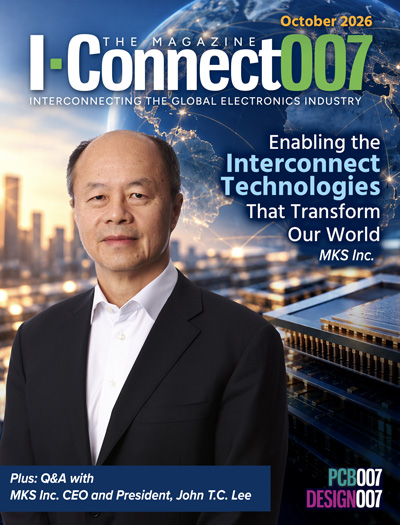
 Marcy’s Musings: A Frighteningly Good October Issue
 It’s Only Common Sense: Win the Sale Before the RFQ Arrives
 The Marketing Minute: Marketing Is a Team Sport






Mitchell: If you compare us with other industry standards, IPC charges one-third the cost.
Matties: Some people said, “If I'm member, I should get standards for free.”
Mitchell: There are some groups that do that, but their dues are about 10-100 times what our dues are.
Matties: Have you considered a survey to see if people would pay higher dues and take free standards? They might prefer it to be inclusive rather than feel like they’re being nickel-and-dimed.
Mitchell: That's true. That's a good thought. We haven't surveyed, but we could look at that. The average association dues, depending on the size and revenue, are somewhere between $10,000 and $110,000. IPC’s are at around $1,100.
Matties: Maybe there's room for you to go up with the reduction of standard prices or making them inclusive.
Mitchell: It's definitely an interesting thought.
Matties: Because then what happens is you're really sharing the material in a way that everybody is a part of and you bring real value coupled with all of the other work.
Mitchell: That would be an interesting thing for me to really ponder. It's something that I would have to hear about from the members, as 80% of the people that are really investing the time on the standards are members. Then suddenly we would just be taking all their blood, sweat and tears and giving it away.
Matties: But only to members.
Mitchell: I guess that's true.
Matties: They're paying for it on the other side. For instance, I'm not going to pay you $1,000 for a membership, I'm going to pay you $10,000, but I'm going to get all the standards I need, all the training I need, and whatever I need is inclusive.
Mitchell: We don't provide all the training, so that would be hard to include. It is an interesting point. Let me think about it.
Matties: That was just some industry feedback. I'm sure it's not everybody, but enough that at least we heard it.
Mitchell: I'm glad you're sharing it with me because the IPC A-610 is a 400-page document with colored pages, etc. To buy that book alone, just the raw cost alone is pretty close to it. But, again, go digital, right?
Matties: I'm surprised you're not, why is that?
Mitchell: It’s the industry. If it's digital, they can't put it on the line unless they have LCD monitors everywhere, so it's a cost to them. With paper, it's there. That's really what it is. There are also digital rights management issues. If it was free to the world, it would be easier to go digital because we wouldn't care, but right now, it's not.
Matties: Those are the kinds of obstacles that can get in the way of being productive.
Mitchell: I'm going to get in trouble on this interview, I can tell you that right now [laughs]. You know, we're always open to trying to figure out what will most benefit the industry. You'll see a couple of things this coming year along those lines. It won't necessarily be standards being given away for free, but I think you're going to see some really interesting value that's not only going to affect just the traditional members, but also future members. By that, I mean the younger generation that we're trying to get more involved in the electronics industry, in the standards development and in technical education.
Matties: That’s good, because I was thinking that the IPC needs a creative mentor program.
Mitchell: We actually have one that’s about to be launched. It was introduced to the TAEC at our fall meetings. Basically, we’re taking the stalwarts of the industry and getting them assigned mentorships and they bring mentees to different committees, events, training sessions, etc.
Matties: Let's just shift gears a little. How is APEX shaping up?
Mitchell: IPC APEX EXPO 2016 is shaping up well. We're in Las Vegas this year and excited about that. We're actually in the convention center, which is a little different for us. Mandalay Bay has a great group over there, but they expanded their facilities and unless you can fill it, that’s an issue. We don't even fill the San Diego Convention Center. After this year, we'll be back in San Diego in 2017.
Matties: Two years in San Diego or just one?
Mitchell: Maybe up to six years; we'll be in San Diego for a while.
Matties: People really like that venue.
Mitchell: It does seem to be very good. It's kind of split. San Diego allows us a lot of drive-in traffic because so much of the industry is there in Southern California. Vegas has a lot of international appeal, while it's viewed as a boondoggle in the states, even if it's not. So we contend with that a little bit. On the flip-side, we get a lot of international people because they like Vegas.
Matties: What’s coming next year that you can talk about?
Mitchell: There are three things that will be going on in 2016 for IPC. First, as I alluded to, we are going to be expanding in Europe. You're going to see a lot more focus there. We have more than 530 members in Europe already and we need to better serve them. There's an opportunity to grow that market and meet the needs there, so you're going to see European expansion as one of our primary focuses in 2016.
Secondarily, and I didn't talk much about this at all, is online training. We have our multimedia group that has done things like DVDs and before that VHS tapes, etc. You're going to see a whole new opportunity in what we offer, not just to our industry, but to potential industries in terms of online training. We are in the process of developing some interesting programs and collaborating with various groups. Think Kahn Academy, but for our type of industry.
The third thing is we are redoing our IT infrastructure internally to try to better improve our serviceability to the members. Right now, we take purchase orders, but it's a completely manual process. You can't enter it yourself, so that's something that we're trying to fix so when people want to work with IPC, it's as easy as working with Amazon or anywhere else. So we're making some investment there to better improve our systems.
Matties: Great. Thank you John, I always enjoy our conversations and it’s always interesting sitting down with you.
Mitchell: Thank you.
Page 4 of 4


