











 Driving Innovation: Mechanical and Optical Processes During Rigid-flex Production
 It’s Only Common Sense: Your Biggest Competitor Is Complacency
 The Chemical Connection: Onshoring PCB Production—Daunting but Certainly Possible





Spinning the Light: The World's Smallest Optical Gyroscope
October 26, 2018 | CaltechEstimated reading time: 2 minutes
Gyroscopes are devices that help vehicles, drones, and wearable and handheld electronic devices know their orientation in three-dimensional space. They are commonplace in just about every bit of technology we rely on every day. Originally, gyroscopes were sets of nested wheels, each spinning on a different axis. But open up a cell phone today, and you will find a microelectromechanical sensor (MEMS), the modern-day equivalent, which measures changes in the forces acting on two identical masses that are oscillating and moving in opposite directions. These MEMS gyroscopes are limited in their sensitivity, so optical gyroscopes have been developed to perform the same function but with no moving parts and a greater degree of accuracy using a phenomenon called the Sagnac effect.
What is the Sagnac Effect?
The Sagnac effect, named after French physicist Georges Sagnac, is an optical phenomenon rooted in Einstein's theory of general relativity. To create it, a beam of light is split into two, and the twin beams travel in opposite directions along a circular pathway, then meet at the same light detector. Light travels at a constant speed, so rotating the device—and with it the pathway that the light travels—causes one of the two beams to arrive at the detector before the other. With a loop on each axis of orientation, this phase shift, known as the Sagnac effect, can be used to calculate orientation.
The Problem
The smallest high-performance optical gyroscopes available today are bigger than a golf ball and are not suitable for many portable applications. As optical gyroscopes are built smaller and smaller, so too is the signal that captures the Sagnac effect, which makes it more and more difficult for the gyroscope to detect movement. Up to now, this has prevented the miniaturization of optical gyroscopes.
The Invention
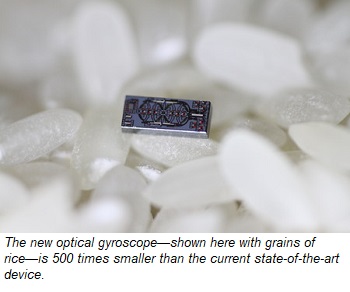
Caltech engineers led by Ali Hajimiri, Bren Professor of Electrical Engineering and Medical Engineering in the Division of Engineering and Applied Science, developed a new optical gyroscope that is 500 times smaller than the current state-of-the-art device, yet they can detect phase shifts that are 30 times smaller than those systems. The new device is described in a paper published in the November issue of Nature Photonics.
How it Works
The new gyroscope from Hajimiri's lab achieves this improved performance by using a new technique called "reciprocal sensitivity enhancement." In this case, "reciprocal" means that it affects both beams of the light inside the gyroscope in the same way. Since the Sagnac effect relies on detecting a difference between the two beams as they travel in opposite directions, it is considered nonreciprocal. Inside the gyroscope, light travels through miniaturized optical waveguides (small conduits that carry light, that perform the same function as wires do for electricity). Imperfections in the optical path that might affect the beams (for example, thermal fluctuations or light scattering) and any outside interference will affect both beams similarly.
Hajimiri's team found a way to weed out this reciprocal noise while leaving signals from the Sagnac effect intact.Reciprocal sensitivity enhancement thus improves the signal-to-noise ratio in the system and enables the integration of the optical gyro onto a chip smaller than a grain of rice.
Share on:


Testimonial
"Your magazines are a great platform for people to exchange knowledge. Thank you for the work that you do."
Simon Khesin - Schmoll MaschinenSuggested Items
BAE Contract Agreed with the Republic of Türkiye for Typhoon Aircraft
10/28/2025 | BAE SystemsThe UK Government has announced a c.£5.4 billion agreement with the Republic of Türkiye for the purchase of 20 Typhoon aircraft and an associated weapons and integration package, sustaining more than 20,000 highly skilled jobs across the UK supply chain.
How PCBA Excellence Transforms High-mix Operations
09/22/2025 | Chintan Sanghani, Electronics Center for ExcellenceWith over 30 years of manufacturing excellence, our organization has built deep expertise in PCBA contract manufacturing for downhole oilfield tools. Through years of focused operational leadership in this demanding sector, we've learned that in high-mix, low-volume (HMLV) environments, traditional manufacturing approaches can create more bottlenecks than breakthroughs.
Advint Incorporated Brings Artificial Intelligence to Electroplating Training
09/11/2025 | Advint IncorporatedAdvint Incorporated is introducing a new dimension to its electroplating training programs: the integration of Artificial Intelligence (AI). This initiative reflects the company’s commitment to providing PCB fabricators and manufacturers in the USA and Canada with training that is practical, forward-looking, and directly relevant to today’s production challenges.
The Signal Integrity Issue: Design007 Magazine September 2025
09/09/2025 | I-Connect007 Editorial TeamAs the saying goes, “If you don’t have signal integrity problems now, you will eventually.” This month, our experts share a variety of design techniques that can help PCB designers and design engineers achieve signal integrity.
Semiconductors Get Magnetic Boost with New Method from UCLA Researchers
07/31/2025 | UCLA NewsroomA new method for combining magnetic elements with semiconductors — which are vital materials for computers and other electronic devices — was unveiled by a research team led by the California NanoSystems Institute at UCLA.