













 Dan’s Biz Bookshelf: ‘The Next RenAIssance: AI and the Expansion of Human Potential’
 The Chemical Connection: When the Industry Moves Faster Than the Standards
 Driving Innovation: Selecting the Right Laser Source





MacDermid Enthone Discusses Consolidation Benefits
January 8, 2019 | Pete Starkey, I-Connect007Estimated reading time: 7 minutes
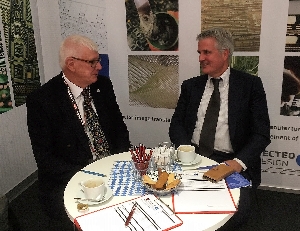
At the 2018 electronica exhibition in Munich, Frando van der Pas, director of marketing and sales for MacDermid Enthone—Europe, and Technical Editor Pete Starkey discussed the consolidation benefits and the vision and future of the company.
Pete Starkey: I’m delighted to meet once more an old friend, Frando van der Pas. It's great to see you again.
Frando Van der Pas: The pleasure is all mine.
Starkey: Frando, it doesn't seem like very long ago that two big names on the chemical process supply side of the industry combined into one organization. Although thinking about it, that may have been three years ago now.
van der Pas: Yes, it was in December 2015 that Platform Specialty Products, which was the parent company of MacDermid, bought Alent—the listed company of Alpha and Enthone, which had come out of Cookson Electronics. And several months before we officially joined, Platform Group also bought the electronics, chemicals, and memory disk business part of OM Group and had already started integrating this into MacDermid.
Starkey: Yes, I remember.
van der Pas: But let's not dwell too long on the history because the future is more important. We are still in the process of integrating MacDermid and Enthone into what you now know as MacDermid Enthone.
Starkey: Certainly, although the industry remembers the names of the legacy companies, I think your new identity is well recognized.
van der Pas: Indeed, and that was initially the reason we decided to maintain the legacy names into our new name. I think that like in any business today, consolidation is an ongoing process, especially in the chemical industry. You see many examples, and a key reason is that as a sizable company, we can bring more value to our customers.
Starkey: Also, from the point of view of product development, you can combine all of your resources, and they will have a synergistic effect on bringing new products to market.
van der Pas: Correct, the synergy from scientists working together toward common goals is an important part of the value. The main benefit of MacDermid and Enthone is, although we served similar markets, there wasn't a great deal of technology overlap. We each had portfolio gaps, and we filled those gaps by bringing the two (really three) companies together into one. Both MacDermid and Enthone had and have a strategy for trying to be a full-line supplier at all levels of interconnect in the electronics industry. As for the semiconductor market, legacy Enthone already had great market share. We now have a full process portfolio for the PCB and connector industries, and we strongly believe that as a full-line supplier, we can bring much more value to our customers.
Integration in our company is an ongoing journey, so what we have done so far is integration in the field of circuitry chemicals. You can imagine all of the hurdles to overcome. We tried to do this without distracting from businesses or relationships, and at the same time, demonstrate more value to our customers.
Starkey: As companies, I believe you've always been recognized as having a very strong forward vision in anticipating the needs of the industry and being prepared for when those needs become apparent, even if the industry itself doesn't recognize what it's going to need next year. You're already planning, developing, and perfecting in the background. What is your perspective on what the industry is going to require from your sort of company?
van der Pas: That is a great question because it gives me a good introduction for giving you some information on the next move in our company’s development.
Starkey: Yes, what are your observations on industry trends and requirements, and how are you preparing yourself for them?
van der Pas: What we see in the industry is that our customers and end users require a much more total solutions-driven company. Although all of our legacy companies have been very strong in certain elements of the electronics industry, MacDermid Enthone is now a more full-line supplier for the industries that we serve and can bring much more value to our customers. Customers and OEM end users are challenging us by requesting a more system-level approach: “What is your solution from the design of our product to the finished goods that we install in a car?”
This is an important trend in the industry in general, which leads us to our next step to formally integrate two of our businesses. From January 2019 onward, the MacDermid Enthone Electronics business will be fully integrated with Alpha Assembly Solutions. Today, we coexist as sister divisions. As of January 1, we will form a new entity called MacDermid Alpha Electronic Solutions.
We are now formalizing our partnership among our circuitry wet chemicals business, our semiconductor wet chemicals business, and our assembly materials business within the electronics industry. Why? Because we strongly believe we can provide even more value to all of our customers and their customers by a more holistic, full-system approach in the electronics industry from the chip to the assembled PCB.
Starkey: It would be sad to lose the Enthone name because there is so much history attached to it, but you must move on.
van der Pas: Yes and no. We will not lose the legacy Enthone name because it will still be a strong brand identity for many of our circuitry, connector, and semiconductor product families. Furthermore, customers will still see the MacDermid Enthone and Alpha names as a product family brand on the chemicals supplied.
Starkey: I understand. In terms of technology, what is the industry demanding of you or what do you foresee will be demanded? Where are your principal areas of process development?
van der Pas: For the printedcircuity solutions part of our product development program, we observe a strong drive on reliability and cost, which normally don't go hand in hand. The industry wants to improve reliability preferably at a lower cost. That is our challenge as a chemical supplier to see if we can provide both.
A high-focus activity right now is ENIG and ENEPIG. We have come out with a new process because there is a change in specifications in the ENIG market. The IPC specifications have changed, and apart from a minimum amount of gold on the PCB, there's also a maximum thickness allowed.
Starkey: Yes, I've seen the spec.
van der Pas: This is interesting for us as a Six-Sigma company to statistically challenge process capability. We are a product development company. What we are trying to do is work on capability improvements of current ENIG processes in the market, and improve our ENIG to address the new IPC specifications. We've come out with an improved process that addresses both elements: reliability through preventing pad corrosion in the nickel. Further, through an improved capability, we save gold deposited on the PCB, allowing for a cost reduction at the same time.
Starkey: Those mechanisms were quite mysterious in years gone by, but I think they have been very comprehensively investigated, resulting in a much better understanding. As a consequence of better understanding, you're in a much better position to develop improved processes.
van der Pas: Absolutely. We have addressed pad corrosion by controlling the phosphorus in the nickel much better and adding some additives to prevent the gold acting as a corroding agent. At the same time, the phosphorus content of the nickel is much better controlled. This means we have a more controlled thickness distribution of gold all over the PCB, which allows for a much more efficient process, improving cost as well as reliability.
Another area of our focus is the increase of electronics in products in general and specifically within automotive. Power electronics require improved ways of heat dissipation. We have an active R&D program to challenge thermal management in electronics and are coming out with new products addressing this.
Starkey: You clearly see thermal vias as one of the preferred methods of heat dissipation.
van der Pas: Absolutely. As you might imagine, automotive is quite an important business for us globally as well as in Europe, and providing new solutions addressing thermal management challenges will be important. Another example of our product development efforts is in the connector space where we continue to look at new plated stacks to address reliability and cost. Several major OEMs are requesting low- or no-whisker finishes to replace tin as a finish.
Starkey: Will the finishes be made of tin alloys still or will there be no tin?
van der Pas: They could be tin alloys, but the direction we are driving at currently is an indium finish.
Starkey: Tell me more.
van der Pas: As you can imagine, indium is not a standard connector finish; therefore, it will require end-user approvals before implementation. We have released several new indium processes that are currently being tested in the market, and the results are very promising.
Starkey: It makes a lot of sense. Thanks for being so open with us. I really appreciate that.
van der Pas: You're welcome.
Share on:


Testimonial
"In a year when every marketing dollar mattered, I chose to keep I-Connect007 in our 2025 plan. Their commitment to high-quality, insightful content aligns with Koh Young’s values and helps readers navigate a changing industry. "
Brent Fischthal - Koh YoungSuggested Items
EPTAC Expands. New HQ in Salem, NH Draws Industry Leaders.
04/30/2026 | EPTAC CorporationEPTAC, a global leader in electronics manufacturing training, has opened its new corporate headquarters and training facility in Salem, New Hampshire, expanding its capacity to support workforce development across North America.
From Backbone to Breakthroughs: I-Connect007 Wraps PCB Materials Series with Focus on Innovation
04/30/2026 | I-Connect007I-Connect007 wraps up its six-part podcast series, PCB Materials: The Backbone and Future of Electronics, with Episode 6 and a discussion focusing on innovation. In Episode 6, Marcy LaRont speaks with Isola CTO Kirk Thompson about a critical turning point for the PCB industry as innovation accelerates. As data rates climb and demands from AI infrastructure, power density, flexible electronics, photonics, and chiplet integration intensify, traditional material assumptions are no longer sufficient.
Sanmina Reports Q2 Fiscal 2026 Financial Results
04/30/2026 | PRNewswireSanmina Corporation, a leading integrated manufacturing solutions company, reported financial results for the second quarter ended March 28, 2026 and outlook for its third fiscal quarter ending June 27, 2026.
Celestica Announces Q1 2026 Financial Results
04/30/2026 | CelesticaWe expect to grow revenue by more than $6.5 billion in 2026 based on our latest Annual Outlook, and we now expect to grow revenue significantly more than this in 2027, as a result of improved visibility and new program wins.
Global Electronics Association and CalcuQuote, an Elisa Industriq Business, Launch Joint Supply Chain Intelligence Initiative
04/29/2026 | Global Electronics AssociationThe Global Electronics Association and CalcuQuote, Elisa Industriq today announced a partnership to deliver timely, actionable supply chain intelligence for the electronics industry.