












 American Made Advocacy: Rebuilding America’s Military Stockpiles Begins With Microelectronics
 The Right Approach: The End of an Era—DoD Proposes MIL-PRF-31032 Cancellation
 Defense Speak Interpreted: Hypersonics Report Back After Six Years of Silence





Attention Researchers: Space, Suborbital, and Climate-Focused Technologies Wanted
July 8, 2021 | NASAEstimated reading time: 1 minute
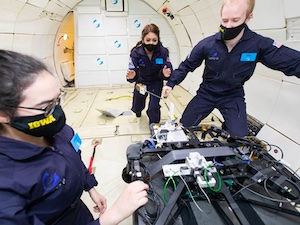
NASA’s 2021 Tech Flights solicitation is now open! Tech Flights offers funding opportunities to researchers from U.S.-based industry, academia, and private research institutions to rapidly test technologies on commercial suborbital vehicles with awards up to $650,000 per awardee.
Through NASA’s Flight Opportunities program, awardees receive a grant or cooperative agreement allowing them to purchase flights directly from any eligible U.S. commercial flight provider that best suits their technology demonstration. These vehicles include suborbital rockets, rocket-powered vertical takeoff, and vertical landing vehicles, high-altitude balloons, and aircraft flying reduced-gravity (e.g., parabolic) flight profiles.
NASA is seeking proposals to address specific agency goals. The topics for the 2021 solicitation are:
- Topic 1: Supporting National Efforts at the Moon and in Cislunar Space, Inclusive of Human and Robotic Exploration and Scientific Discovery
- Topic 2: Earth-Observing Capabilities to Support Breakthrough Science and National Efforts to Address Climate Change
- Topic 3: Technologies that Ensure National Leadership in Space and Help the Commercial Space Industry Grow
Examples of technologies that address these topics and much more information can be found in the full Tech Flights 2021 solicitation.
Preliminary proposals are due July 26, 2021, and full proposals (by invitation only based on preliminary proposal acceptance) are due Oct. 4, 2021. Awardee selections are targeted for December 2021 with awards targeted for February 2022. These dates are subject to change.
A question and answer session is scheduled for July 14, 2021, at 10 a.m. PDT.
Share on:


Testimonial
"Advertising in PCB007 Magazine has been a great way to showcase our bare board testers to the right audience. The I-Connect007 team makes the process smooth and professional. We’re proud to be featured in such a trusted publication."
Klaus Koziol - atgSuggested Items
Boeing-built Space Launch System Core Stage Powers First Crewed Artemis Mission around the Moon
04/02/2026 | BoeingNASA's Space Launch System rocket, powered by the Boeing-built core stage, lifted off at 6:35 p.m. ET. Eight and a half minutes into flight, the core stage successfully completed its mission and separated from the upper stage of the rocket, enabling NASA's Orion spacecraft, Integrity, to carry humankind around the moon.
Renesas’ Radiation-Hardened ICs Take Flight on NASA’s Artemis II Crewed Lunar Mission
04/02/2026 | BUSINESS WIRERenesas Electronics Corporation, a premier supplier of advanced semiconductor solutions, today announced its radiation-hardened (rad-hard) ICs are being used in NASA’s Artemis II mission, which successfully launched from the Kennedy Space Center in Florida on April 1.
DesignCon Taps NASA, Purdue, and Agentrys for Keynote Slate
02/24/2026 | GlobeNewswireDesignCon, the premiere event for the latest in high-speed design tools, technologies, and developments, has announced the keynote speakers for the 2026 edition.
Starlab Completes NASA Commercial Critical Design Review
02/23/2026 | BUSINESS WIREStarlab Space LLC, developer of a next-generation commercial space station, has successfully completed its Commercial Critical Design Review (CCDR) with NASA in attendance, marking a decisive transition from design to manufacturing and systems integration.
NASA’s SunRISE SmallSats Ace Tests, Moving Closer to Launch
01/26/2026 | NASA JPLThe small satellites passed a crucible of tests, ending with a simulation of the intense vibrations of launch.