














 Flexible Thinking: Designing Flex Circuits for Dynamic Reliability
 Global PCB Connections: Rigid-flex and Flexible PCBs—The Backbone of Modern Electronics
 Happy’s Tech Talk #29: Bend-to-Install Semi-flex FR-4





Technique Speeds Up Thermal Actuation for Soft Robotics
December 16, 2021 | North Carolina State UniversityEstimated reading time: 2 minutes
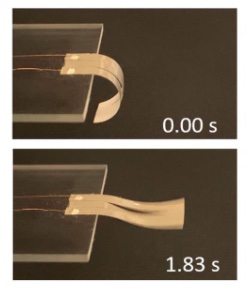
Researchers from North Carolina State University have come up with a new design for thermal actuators, which can be used to create rapid movement in soft robotic devices.
“Using thermal actuation is not new for soft robots, but the biggest challenge for soft thermal actuators was that they were relatively slow – and we’ve made them fast,” says Yong Zhu, corresponding author of the paper and the Andrew A. Adams Distinguished Professor of Mechanical and Aerospace Engineering at NC State.
Actuators are the parts of a device – such as a soft robot – that create motion by converting energy into work.
“What makes this new actuator design work is a structure with a bi-stable design,” says Shuang Wu, first author of the paper and a Ph.D. student at NC State. “Think of a snap hair clip. It’s stable until you apply a certain amount of energy (by bending it over), and then it snaps into a different shape – which is also stable.”
In the case of the new thermal actuator, the material is bi-stable, but which shape the material prefers is dictated by temperature.
Here’s how that works. The researchers layer two materials on top of each other, with silver nanowires in the middle. The two materials have different coefficients of thermal expansion, which means they expand at different rates as they heat up. In practical terms, that means the structure bends when you heat it.
This layered material is then shaped into a design that gives it a default curvature in one direction – let’s say that it curves downward. When voltage is applied to the silver nanowires, the material heats up, making it bend in the other direction. Once you reach a certain temperature – the critical temperature – the material snaps into its new default shape, curving up rapidly. When the voltage is removed, the temperature goes back down. Once it cools past another critical temperature, the material snaps back to its previous default shape, curving down rapidly. Note that the two critical temperatures are different; the first one is higher. By applying current to the nanowires in a regular pattern, you can make the material snap back and forth.
To demonstrate the technique, the researchers created two prototypes. One of the prototypes emulates the snapping behavior of a Venus flytrap, while the other is a “crawler” capable of moving more than one body length per second.
“Potential applications range from biomedical applications to prosthetic devices to high-end manufacturing,” Zhu says. “Any application in which you’d want to be able to move quickly, but also want to avoid rigid materials and conventional robotics.”
Next steps include developing sensor and control mechanisms that could more fully automate the actuation process, allowing it to operate more efficiently than purely manual controls.
“We’re also interested in exploring other possible materials, so that we could fine-tune the thermal and mechanical properties,” Zhu says. “This could allow us to tailor both actuator speed and force.”
Read the original article, here.
Share on:


Testimonial
"Your magazines are a great platform for people to exchange knowledge. Thank you for the work that you do."
Simon Khesin - Schmoll MaschinenSuggested Items
Green Circuits Heads to Peterson SFB to Support Next-Gen Space and Defense Electronics
05/05/2026 | Green CircuitsThe event, hosted at Peterson Space Force Base, brings together key personnel and mission partners supporting critical U.S. defense and space operations.
JAVAD EMS to Add New ESPEC Temperature Chamber to Support Growing Mil/Aero Work
04/28/2026 | JAVAD EMSJAVAD EMS (JEMS), a leading global EMS company that provides low to medium volume, high-mix applications, has ordered a new ESPEC EGNZ28-15NW temperature cycling chamber to expand its environmental testing capabilities as demand continues to grow in the military and aerospace sectors.
Global Turbine Asia Boosts Aerospace Growth and Talent Through Strategic Partnerships
04/21/2026 | ACN NewswireThe MoUs reflect GTA’s strategic focus on strengthening the aerospace and defence ecosystem through cross-border commercial cooperation, talent development, research partnerships and long-term capability building, aligned with evolving regional industry needs.
Spirit Electronics Named Authorized Distributor for Microchip Technology
04/17/2026 | Globe NewswireSpirit Electronics, a vertically integrated electronics design and manufacturing solutions provider serving the military and aerospace markets, announced that it has been designated as an authorized distributor for the Americas for Microchip Technology, a broadline supplier of semiconductors committed to making innovative design easier through total system solutions.
FTG Reports Strong Q1 2026 Results with Double-Digit Revenue Growth and Rising Backlog
04/09/2026 | Firan Technology Group CorporationIn Q1 2026, the Corporation grew organically. FTG is strategically investing its capital in ways that will drive increased shareholder returns for the future in both the near term and long term. The company's achievements in Q1 2026 demonstrate this commitment, laying a strong foundation for future growth.