











 Driving Innovation: Selecting the Right Laser Source
 Dan’s Biz Bookshelf: ‘Notorious: Leadership Lessons From History’s Most Notorious Leaders’ (New Audio Version)
 It's Only Common Sense: See Your Marketing as a Discipline, Not a Department





Nanomaterial Wrap for Improved Tissue Imaging
August 22, 2017 | Tokai UniversityEstimated reading time: 2 minutes
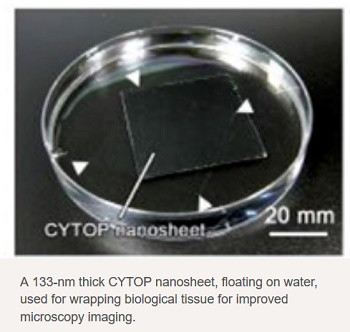
Researchers at Tokai University describe in Advanced Materials how wrapping biological tissue in a nanosheet of a particular organic material results in high-quality microscopy images. Application of the wrap prevents the sample from drying out, and hence from shrinking, enabling larger image-recording times.
In order to fully understand how biological cells function, it is important to be able to visualize them in their environment, on long-enough timescales and with high-enough resolution. However, typical setups for studying a biological tissue sample by means of optical microscopy do not prevent the sample from drying out, making it shrink during observation, resulting in blurred images. But now, a team of researchers led by Yosuke Okamura from Tokai University, has discovered how to overcome this problem: wrapping the sample in a fluoropolymer nanosheet preserves its water content, and the sheet's strong adhesion makes it mountable.
The researchers, who were inspired by the use of plastic food wrap, investigated the wrapping properties of a fluorine-containing polymer known as CYTOP, a stiff but stretchable and highly optically transparent material. They first confirmed that due to its high water-repellency, a nanosheet of CYTOP floats on water, even after adding a surfactant. Scanning-electron-microscopy observations revealed that the nanosheet is flat and free of cracks or wrinkles.
As a first test of CYTOP as a wrapper material for biological tissues, the researchers coated a cylindrically shaped alginate-hydrogel -- an easily formable biomaterial -- sample in a CYTOP nanosheet, and monitored the evolution of its water content. They found that after 24 hours, 60% of the original water content was still present. (A similar sample left unwrapped in air became totally dehydrated after about 10 hours.) Through experimenting with various thicknesses, the scientists discovered that the nanosheet's water-retention capability increases proportionally with its thickness. They concluded that a 133-nm-thick sheet offers sufficient surface adhesion (necessary for fixing the sample) and water retention.
The researchers then performed experiments with an actual biological sample: 1-mm thick brain slices from mice, exhibiting enhanced expression of yellow fluorescent protein for visualisation purposes. Without applying a CYTOP wrap, evaporation of the embedded water caused local, non-uniform sample shrinkage, leading to a blurred image. By wrapping the brain slices in a CYTOP nanosheet, however, images with a high spatial resolution could be obtained from scanning a large area (more than 750 µm x 750 µm) over a long time (about 2 hours).
The scientists noted, however, that for observations over longer time spans shrinkage will occur. This effect can be compensated by embedding the sample with agarose, a gel-forming material, providing a stability matrix -- a technique already used for mounting biological tissues for microscopy observations. The wrapping technique of Okamura and colleagues is still at an early stage, but, as the researchers point out, it "establishes and verifies the superiority of nanosheet wrapping mounts for tissue imaging".
Share on:



Subscribe
Stay ahead of the technologies shaping the future of electronics with our latest newsletter, Advanced Electronics Packaging Digest. Get expert insights on advanced packaging, materials, and system-level innovation, delivered straight to your inbox.Subscribe now to stay informed, competitive, and connected.
Suggested Items
Gregoire Outters Promoted to President of Teledyne Marine Group
04/06/2026 | TeledyneTeledyne Technologies Incorporated announced the promotion of Gregoire Outters to President of its Teledyne Marine Group.
Teledyne Strengthens Commitment to the Space Sector
04/01/2026 | BUSINESS WIRETeledyne Technologies Incorporated is excited to announce the integration of the company’s extensive portfolio of space-focused technologies and businesses, reinforcing its long-term commitment to the global space sector.
Teledyne to Supply Detectors for Lazuli Space Observatory
03/30/2026 | BUSINESS WIRETeledyne Space Imaging, part of Teledyne Technologies Incorporated has been awarded a contract by Schmidt Sciences to deliver advanced near-infrared (NIR) H4RG-10 flight focal plane arrays (FPAs) and custom electronics for integration into the Integral Field Spectrograph on the groundbreaking Lazuli Space Observatory.
New Superconducting Chip Could Enable Breakthrough Nondestructive Terahertz Imaging
03/23/2026 | University of GlasgowA tiny crystal chip which uses terahertz radiation to see clearly through a wide range of materials could find applications in healthcare, biological research, and security screening.
The Test Connection Adds Creative Electron Prime TruVision™ X-ray and CT System for Deeper Failure Analysis
03/05/2026 | TTCIThe Test Connection Inc. (TTCI), a trusted provider of electronic test and manufacturing solutions for more than 45 years, has added the Prime TruVision™ X-ray and computed tomography (CT) inspection system from Creative Electron to its engineering and analysis services.