











 Dan’s Biz Bookshelf: ‘The Next RenAIssance: AI and the Expansion of Human Potential’
 The Chemical Connection: When the Industry Moves Faster Than the Standards
 Driving Innovation: Selecting the Right Laser Source





Scientists Create World’s First ‘Molecular Robot’ Capable of Building Molecules
September 21, 2017 | University of ManchesterEstimated reading time: 2 minutes
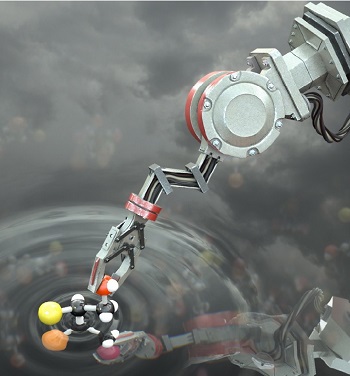
Scientists at The University of Manchester have created the world’s first ‘molecular robot’ that is capable of performing basic tasks including building other molecules.
The tiny robots, which are a millionth of a millimetre in size, can be programmed to move and build molecular cargo, using a tiny robotic arm.
Each individual robot is capable of manipulating a single molecule and is made up of just 150 carbon, hydrogen, oxygen and nitrogen atoms. To put that size into context, a billion billion of these robots piled on top of each other would still only be the same size as a single grain of salt.
The robots operate by carrying out chemical reactions in special solutions which can then be controlled and programmed by scientists to perform the basic tasks.
In the future such robots could be used for medical purposes, advanced manufacturing processes and even building molecular factories and assembly lines.
Professor David Leigh, who led the research at University’s School of Chemistry, explains: ‘All matter is made up of atoms and these are the basic building blocks that form molecules. Our robot is literally a molecular robot constructed of atoms just like you can build a very simple robot out of Lego bricks. The robot then responds to a series of simple commands that are programmed with chemical inputs by a scientist.
‘It is similar to the way robots are used on a car assembly line. Those robots pick up a panel and position it so that it can be riveted in the correct way to build the bodywork of a car. So, just like the robot in the factory, our molecular version can be programmed to position and rivet components in different ways to build different products, just on a much smaller scale at a molecular level.’
The benefit of having machinery that is so small is it massively reduces demand for materials, can accelerate and improve drug discovery, dramatically reduce power requirements and rapidly increase the miniaturisation of other products. Therefore, the potential applications for molecular robots are extremely varied and exciting.
Prof Leigh says: ‘Molecular robotics represents the ultimate in the miniaturisation of machinery. Our aim is to design and make the smallest machines possible. This is just the start but we anticipate that within 10 to 20 years molecular robots will begin to be used to build molecules and materials on assembly lines in molecular factories.’
Whilst building and operating such tiny machine is extremely complex, the techniques used by the team are based on simple chemical processes.
Prof Leigh added: ‘The robots are assembled and operated using chemistry. This is the science of how atoms and molecules react with each other and how larger molecules are constructed from smaller ones.
‘It is the same sort of process scientists use to make medicines and plastics from simple chemical building blocks. Then, once the nano-robots have been constructed, they are operated by scientists by adding chemical inputs which tell the robots what to do and when, just like a computer program.’
Share on:



Subscribe
Stay ahead of the technologies shaping the future of electronics with our latest newsletter, Advanced Electronics Packaging Digest. Get expert insights on advanced packaging, materials, and system-level innovation, delivered straight to your inbox.Subscribe now to stay informed, competitive, and connected.
Suggested Items
Dan’s Biz Bookshelf: ‘The Next RenAIssance: AI and the Expansion of Human Potential’
04/29/2026 | Dan Beaulieu -- Column: Dan's Biz BookshelfZack Kass delivers something truly special in "The Next RenAIssance: AI and the Expansion of Human Potential," a book that doesn’t just explain artificial intelligence—it reframes how we think about our future as individuals, leaders, and innovators. Written in a tone that is both accessible and deeply insightful, Kass manages to turn a complex, often intimidating subject into an energizing call to action. This is not a book about machines replacing humans. It’s a book about humans becoming more of who they’re capable of being.
Dan’s Biz Bookshelf: ‘The 'NVIDIA Way: Jensen Huang and the Making of a Tech Giant’
04/09/2026 | Dan Beaulieu -- Column: Dan's Biz BookshelfI just finished "The NVIDIA Way" by Tae Kim, and let me tell you, this isn’t just a book about a semiconductor company. It’s a book about conviction, stubborn vision, and, most of all, what happens when a leader refuses to think small. At the center of it all is Jensen Huang. Kim does a masterful job showing us that NVIDIA’s rise wasn’t luck, timing, or some Silicon Valley fairy dust. It was discipline and obsession. It was long-term thinking in a world addicted to quarterly results.
From PEDC to APEX: Banyan.eco’s Disruptive AI for EMS and OEM Companies
03/17/2026 | Marcy LaRont, I-Connect007The electronics industry’s struggle with supply chain resilience and increasing regulatory complexity has created a costly compliance challenge for OEMs and EMS providers alike. At the same time, advances in artificial intelligence are opening new possibilities for automating some of the industry’s most data-intensive tasks. At the Pan-European Design Conference (PEDC), Banyan.eco cofounder Francis D’Souza introduced a new approach that combines AI-driven data acquisition with a deterministic verification layer to eliminate compliance risk from AI hallucination and dramatically improve productivity.
It’s Only Common Sense: Reinvention Is a Fundamental Leadership Responsibility
03/02/2026 | Dan Beaulieu -- Column: It's Only Common SenseIf you’re waiting until the numbers drop, the customers leave, or your competitors catch up before you reinvent your business practices, you’ve already lost. Reinvention is a fundamental leadership responsibility, and successful companies reinvent themselves before they have to. They see it not as a rescue mission, but as a rhythm: questioning, disrupting, and rebuilding before market forces force their hand. Leaders who change only when cornered are followers pretending to lead.
Standard of Excellence: Building the Board of the Future—Materials, Methods, and Mindset
02/18/2026 | Anaya Vardya -- Column: Standard of ExcellenceThe future of PCB manufacturing is here. The products we’re being asked to build today would have been called “advanced” just a few years ago. What was once special is now standard, and what was once impossible is now expected. The challenge and the opportunity lie in leading the charge to the next frontier of printed circuit board design, materials, and manufacturing discipline. To build the board of the future, we need new materials, smarter methods, and a mindset of innovation anchored in flawless execution.