













 Dan’s Biz Bookshelf: ‘Abundance: How We Build a Better Future’
 Trouble in Your Tank: In Complex Systems, Design Rules Aren’t Optional
 It’s Only Common Sense: The Phone Is Still Your Competitive Advantage





Hybrid FinFET-Silicon Photonics Technology for Ultra-Low Power Optical I/O
July 10, 2018 | ImecEstimated reading time: 2 minutes
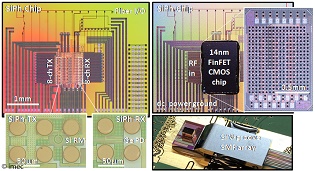
Imec, the world-leading research and innovation hub in nano-electronics and digital technology, announced that it has demonstrated ultra-low power, high-bandwidth optical transceivers through hybrid integration of Silicon Photonics and FinFET CMOS technologies. With a dynamic power consumption of only 230fJ/bit and a footprint of just 0.025mm2, the 40Gb/s non-return-to-zero optical transceivers mark an important milestone in realizing ultra-dense, multi-Tb/s optical I/O solutions for next-generation high-performance computing applications.
The exponentially growing demand for I/O bandwidth in datacenter switches and high-performance computing nodes is driving the need for tight co-integration of optical interconnects with advanced CMOS logic, covering a wide range of interconnect distances (1m-500m+). In the presented work, a differential FinFET driver was co-designed with a Silicon Photonics ring modulator, and achieved 40Gb/s NRZ optical modulation at 154fJ/bit dynamic power consumption. The receiver included a FinFET trans-impedance amplifier (TIA) optimized for operation with a Ge waveguide photodiode, enabling 40Gb/s NRZ photodetection with an estimated sensitivity of -10dBm at 75fJ/bit power consumption. High-quality data transmission and reception was also demonstrated in a loop-back experiment at 1330nm wavelength over standard single mode fiber (SMF) with 2dB link margin. Finally, a 4x40Gb/s, 0.1mm2 wavelength-division multiplexing (WDM) transmitter with integrated thermal control was demonstrated, enabling bandwidth scaling beyond 100Gb/s per fiber.
“The demonstrated hybrid FinFET-Silicon Photonics platform integrates high-performance 14nm FinFET CMOS circuits with imec’s 300mm Silicon Photonics technology through dense, low-capacitance Cu micro-bumps. Careful co-design in this combined platform has enabled us to demonstrate 40Gb/s NRZ optical transceivers with extremely low power consumption and high bandwidth density,” says Joris Van Campenhout, director of the Optical I/O R&D program at imec. “Through design optimizations, we expect to further improve the single-channel data rates to 56Gb/s NRZ. Combined with wavelength-division multiplexing, these transceivers provide a scaling path to ultra-compact, multi-Tb/s optical interconnects, which are essential for next-generation high-performance systems.”
This work has been carried out as part of imec’s industrial affiliation R&D program on Optical I/O and was presented at the 2018 Symposia on VLSI Technology and Circuits (June 2018) in a “late news” paper. Imec’s 200mm and 300mm Silicon Photonics technologies are available for evaluation by companies and academia through imec’s prototyping service and the iSiPP50G multi-project wafer (MPW) service.
About imec
Imec is the world-leading research and innovation hub in nanoelectronics and digital technologies. The combination of our widely acclaimed leadership in microchip technology and profound software and ICT expertise is what makes us unique. By leveraging our world-class infrastructure and local and global ecosystem of partners across a multitude of industries, we create groundbreaking innovation in application domains such as healthcare, smart cities and mobility, logistics and manufacturing, energy and education.
As a trusted partner for companies, start-ups and universities we bring together close to 4,000 brilliant minds from over 85 nationalities. Imec is headquartered in Leuven, Belgium and has distributed R&D groups at a number of Flemish universities, in the Netherlands, Taiwan, USA, China, and offices in India and Japan. In 2017, imec's revenue (P&L) totaled 546 million euro. Further information on imec can be found here.
Share on:



Subscribe
Stay ahead of the technologies shaping the future of electronics with our latest newsletter, Advanced Electronics Packaging Digest. Get expert insights on advanced packaging, materials, and system-level innovation, delivered straight to your inbox.
Subscribe now to stay informed, competitive, and connected.
Suggested Items
Flex Plans Cloud and Power Unit Spin-Off
05/08/2026 | FlexFlex announced that its Board of Directors has unanimously approved moving forward with a plan to spin off its Power and Cloud portfolio from Flex, creating two independent, publicly traded companies, each optimally positioned to serve their customers and create value for their shareholders.
Flex Completes Acquisition of Electrical Power Products (EP²)
05/06/2026 | PRNewswireFlex announced the completion of its acquisition of Electrical Power Products, Inc. (EP²), a leading provider of engineered‑to‑order electrical power control and protection systems.
Advent Diamond, Northrop Grumman Set Record for Diamond-Based Solid-State Limiters
05/06/2026 | PRNewswireAdvent Diamond Inc. and Northrop Grumman have set a new performance record for solid state limiters made from engineered diamond. The device successfully handled more than 100 Watts of power while providing reliable protection for projected radio frequency (RF) applications.
North American AI Data Center Expansion Drives 2026 CapEx of Top Nine CSPs to US$830 Billion
05/06/2026 | TrendForceTrendForce’s latest findings on the AI industry highlight that several major North American CSPs have recently raised their 2026 capital expenditure (CapEx) guidance in response to strong AI demand.
NASA Fires Up Powerful Lithium-Fed Thruster for Trips to Mars
05/04/2026 | NASA JPLA novel electromagnetic thruster passed an initial test in a specialized chamber at JPL. With further development, these thrusters could support human missions to the Red Planet.