














 It’s Only Common Sense: Hire for Hunger, Train for Skill
 Dan’s Biz Bookshelf: ‘The 'NVIDIA Way: Jensen Huang and the Making of a Tech Giant’





Spinning the Light: The World's Smallest Optical Gyroscope
October 26, 2018 | CaltechEstimated reading time: 2 minutes
Gyroscopes are devices that help vehicles, drones, and wearable and handheld electronic devices know their orientation in three-dimensional space. They are commonplace in just about every bit of technology we rely on every day. Originally, gyroscopes were sets of nested wheels, each spinning on a different axis. But open up a cell phone today, and you will find a microelectromechanical sensor (MEMS), the modern-day equivalent, which measures changes in the forces acting on two identical masses that are oscillating and moving in opposite directions. These MEMS gyroscopes are limited in their sensitivity, so optical gyroscopes have been developed to perform the same function but with no moving parts and a greater degree of accuracy using a phenomenon called the Sagnac effect.
What is the Sagnac Effect?
The Sagnac effect, named after French physicist Georges Sagnac, is an optical phenomenon rooted in Einstein's theory of general relativity. To create it, a beam of light is split into two, and the twin beams travel in opposite directions along a circular pathway, then meet at the same light detector. Light travels at a constant speed, so rotating the device—and with it the pathway that the light travels—causes one of the two beams to arrive at the detector before the other. With a loop on each axis of orientation, this phase shift, known as the Sagnac effect, can be used to calculate orientation.
The Problem
The smallest high-performance optical gyroscopes available today are bigger than a golf ball and are not suitable for many portable applications. As optical gyroscopes are built smaller and smaller, so too is the signal that captures the Sagnac effect, which makes it more and more difficult for the gyroscope to detect movement. Up to now, this has prevented the miniaturization of optical gyroscopes.
The Invention
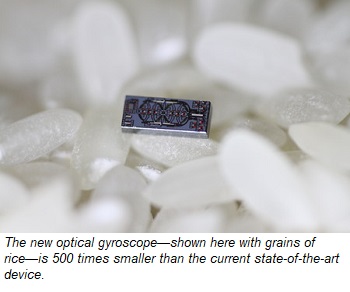
Caltech engineers led by Ali Hajimiri, Bren Professor of Electrical Engineering and Medical Engineering in the Division of Engineering and Applied Science, developed a new optical gyroscope that is 500 times smaller than the current state-of-the-art device, yet they can detect phase shifts that are 30 times smaller than those systems. The new device is described in a paper published in the November issue of Nature Photonics.
How it Works
The new gyroscope from Hajimiri's lab achieves this improved performance by using a new technique called "reciprocal sensitivity enhancement." In this case, "reciprocal" means that it affects both beams of the light inside the gyroscope in the same way. Since the Sagnac effect relies on detecting a difference between the two beams as they travel in opposite directions, it is considered nonreciprocal. Inside the gyroscope, light travels through miniaturized optical waveguides (small conduits that carry light, that perform the same function as wires do for electricity). Imperfections in the optical path that might affect the beams (for example, thermal fluctuations or light scattering) and any outside interference will affect both beams similarly.
Hajimiri's team found a way to weed out this reciprocal noise while leaving signals from the Sagnac effect intact.Reciprocal sensitivity enhancement thus improves the signal-to-noise ratio in the system and enables the integration of the optical gyro onto a chip smaller than a grain of rice.
Share on:


Testimonial
"Advertising in PCB007 Magazine has been a great way to showcase our bare board testers to the right audience. The I-Connect007 team makes the process smooth and professional. We’re proud to be featured in such a trusted publication."
Klaus Koziol - atgSuggested Items
Flexible Thinking: Designing Flex Circuits for Dynamic Reliability
04/09/2026 | Joe Fjelstad -- Column: Flexible ThinkingFlex circuits flex. No surprises there. However, they are also very commonly designed into products because they are thin and offer consistent thickness and dielectric properties, attributes highly prized by present-day product designers of personal electronics. This would include smartphones and, increasingly, wearable electronics for medical monitoring and even fashion.
My Top 7 Takeaways from APEX EXPO 2026
04/03/2026 | Chris Mitchell, VP of Global Government Relations, Global Electronics AssociationI’m back from APEX EXPO 2026 in Anaheim, California, and it was another great year. Even amid significant global volatility, the industry is growing, innovating, and building partnerships. As I reflect on the experience, I want to share my top 7 takeaways and explain why each matters. First is this year’s Advanced Electronics Packaging Conference (AEPC) , which delivered outstanding, peer-reviewed content and strong participation, reflecting how central advanced electronics packaging has become across the industry.
APEX EXPO Opens Today With Ribbon Cutting and Sold-Out Show Floor
03/17/2026 | Michelle Te, I-Connect007APEX EXPO officially opens today with a ribbon-cutting ceremony welcoming attendees onto the sold-out show floor in Anaheim, California. Standards committee meetings and professional development courses have been underway since the weekend, but Tuesday marks the official opening of the exhibition as more than 400 exhibitors prepare to showcase their latest equipment, materials, and technologies across 140,000 square feet of exhibit space.
Finding Your Marketing Niche in a Crowded PCB Industry
03/10/2026 | Richard Nichols, GreenSource EngineeringI recently made a flippant comment on LinkedIn, “All marketing and no trousers,” hinting that marketing campaigns often do not have a tangible product to market and the campaign is marketing a concept or a gut feeling. For PCB and IC substrate manufacturers, this poses a great risk for unsuccessful campaigns and the opportunity to innovate in an increasingly competitive and global landscape.
Beyond the Board: How Advanced PCB Design Is Reshaping Mil/Aero Electronics
03/10/2026 | Jesse Vaughan -- Column: Beyond the BoardAs mil/aero electronics evolve toward higher data rates, greater processing density, and tighter mechanical envelopes, integration is no longer occurring primarily at the box level, but rather deep within the electronic architecture itself, often beginning at the printed circuit board.