














 It’s Only Common Sense: Hire for Hunger, Train for Skill
 Dan’s Biz Bookshelf: ‘The 'NVIDIA Way: Jensen Huang and the Making of a Tech Giant’





Semiconductor Industry Calls for Bold Federal Policies
April 4, 2019 | SIAEstimated reading time: 2 minutes
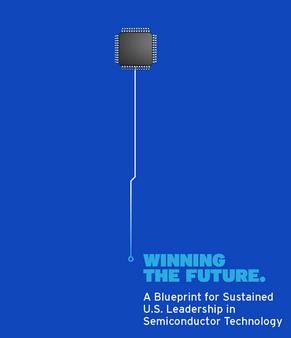
The Semiconductor Industry Association (SIA) has released a set of government policy recommendations for sustaining and strengthening America’s global leadership in semiconductor technology and ensuring the United States wins the race to harness the transformative, semiconductor-enabled technologies of the future, including artificial intelligence, quantum computing, and advanced wireless networks.
The report, titled "Winning the Future: A Blueprint for Sustained U.S. Leadership in Semiconductor Technology," urges U.S. government leaders to significantly increase investments in semiconductor research, help attract and develop the world’s most skilled technology workforce, and ensure open markets and strong protection of intellectual property. SIA represents U.S. leadership in semiconductor manufacturing, design, and research.
“Global technology leadership has never been more important, with so much at stake for America’s future economic growth and competitiveness,” said Sanjay Mehrotra, president and CEO of Micron Technology and 2019 SIA chair. “The country that leads in semiconductor innovation will also lead the next wave of technology advances, influencing every aspect of the economy and life. We call upon our leaders in Washington to enact policies that will keep us at the forefront of the must-win technologies of the future.”
The Winning the Future blueprint highlights two core challenges to continued semiconductor innovation and U.S. leadership in this sector. First, semiconductor technology advancements are pushing against barriers of physics, and breakthroughs to move beyond these limits and keep America in front require greater investment in research. Second, while the U.S. semiconductor industry leads the world with nearly half of global market share, overseas governments such as China’s are seeking to challenge U.S. leadership by making significant investments to achieve breakthroughs in semiconductor technology, artificial intelligence, and quantum computing.
The report identifies three domestic policy areas—research, workforce, and trade/IP protection—where urgent government action is needed to ensure America rises to these challenges and sustains its global leadership in semiconductor technology and the revolutionary technologies semiconductors enable.
Research: Winning the Future calls for tripling federal investments in semiconductor-specific research over the next five years from approximately $1.5 billion to $5 billion annually and doubling federal funding for semiconductor-related research from about $20 billion to $40 billion annually in fields such as materials science, computer science, engineering, and applied mathematics across federal scientific agencies.
Workforce: The blueprintcalls for removing caps on green cards for qualified STEM graduates to meet short-term demand for talent. To develop the future American semiconductor workforce, the report urges increasing federal funding for STEM education by 50% over the next five years from more than $1 billion to over $1.5 billion annually and implementing a national STEM education initiative to double the number of American STEM graduates by 2029.
Trade and IP Protection: The blueprint urges approval of free trade agreements, including the United States-Mexico-Canada Agreement, that remove market barriers, protect IP, and enable fair competition. It also calls for increased resources for law enforcement and intelligence agencies to prevent and prosecute semiconductor IP theft.
“Many of society’s big challenges can be solved by tiny semiconductors, the brains of our digital world,” said John Neuffer, SIA president & CEO. “America’s longstanding leadership in semiconductor technology rests on three pillars: U.S. companies’ pioneering research, unparalleled workforce, and unfettered ability to sell leading-edge products to customers around the world. Congress and the Administration should enact policies that reinforce these pillars and keep America at the head of the class in semiconductor technology.”
Share on:


Testimonial
"Advertising in PCB007 Magazine has been a great way to showcase our bare board testers to the right audience. The I-Connect007 team makes the process smooth and professional. We’re proud to be featured in such a trusted publication."
Klaus Koziol - atgSuggested Items
Long Night of Research 2026: AT&S Brings Artificial Intelligence to Life
04/15/2026 | AT&SWhen the Long Night of Research takes place throughout Austria on Friday, April 24, setting an example for the country’s innovative strength, AT&S will be there with a special highlight.
Foxconn Recognized as Top 100 Global Innovators 2026
04/14/2026 | FoxconnHon Hai Technology Group (Foxconn) has been named in Clarivate’s Top 100 Global Innovators 2026, a milestone for the ninth year running and as the accelerating role of artificial intelligence stood out in innovation activity among peers in the prestigious ranking.
RTX's Raytheon Unveils First Event-Based MWIR Camera for Real-Time High-Speed Threat Tracking
04/13/2026 | PRNewswireRaytheon, an RTX business, successfully demonstrated a new event-based mid-wave infrared (MWIR) camera that tracks high speed objects in real time while dramatically reducing processing and power demands.
SMTA Ultra HDI Symposium, Day 1: AI at the Core or Out of the Game
04/13/2026 | Marcy LaRont, I-Connect007It was a beautiful 81°F morning in Arizona last Wednesday as I headed to the third annual SMTA Ultra HDI Symposium, focused on AI and ultra high density interconnect technology. Strategically held as part of Arizona’s Tech Week, this year’s conference took place in Avondale in Phoenix's West Valley. The event moved from the cozy offices of the Peoria Sports Complex (which paid homage to baseball’s spring training world) to the larger Avondale Conference Center, highlighting the importance of this area for electronics manufacturing investment.
Gartner Forecasts Worldwide Semiconductor Revenue to Exceed $1.3 Trillion in 2026
04/10/2026 | Gartner, Inc.Global semiconductor revenue is projected to exceed $1.3 trillion in 2026, exhibiting the highest growth in the last two decades, according to Gartner, Inc., a business and technology insights company.