













 Dan’s Biz Bookshelf: ‘Abundance’
 Trouble in Your Tank: In Complex Systems, Design Rules Aren’t Optional
 It’s Only Common Sense: The Phone Is Still Your Competitive Advantage





Chuck Bauer: SMTAI 2019 Founder's Award Recipient
October 14, 2019 | I-Connect007 Editorial TeamEstimated reading time: 4 minutes
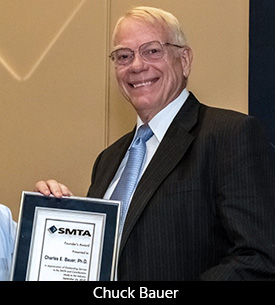
At the recent SMTAI conference and exhibition, Chuck Bauer, Ph.D., senior managing director at TechLead Corporation, has received the Founder's Award. According to SMTA, the Founder's Award is presented to a member who has made exceptional contributions to the industry and provided ongoing support and service to the SMTA. Chuck spoke with Nolan Johnson and Happy Holden about the different conferences and organizations he has been involved with and their importance when it comes to passing the torch to the next generation.
Nolan Johnson: Chuck, you just received SMTA Founder's Award. You thanked two main people in your acceptance speech: Wally Doeling, and your wife, Priscilla. How did Wally and the others impact your life?
Bauer: Wally was a unique individual because I never saw him ever do anything for himself. The lessons he taught me were to share my perspective on the world. He was a great luminary, just like the others I mentioned in my speech, and I knew all of them very well. Dave Packard was in the same fraternity I was at Stanford, and he came back to visit us when he was the U.S. Deputy Secretary of Defense; I had dinner with him at least half a dozen times. I was on an airplane with him from Washington, D.C., to Denver about six months before he passed away. Also, Howard Vollum sat down at my desk when I first joined Tektronix in 1978. I met Gordon Moore and Bob Noyce a few times at SEMATECH, including a barbeque at Bob Noyce’s house while I was at Coors MicroLithics. Tsuyoshi Kawanishi was the vice-chairman of Toshiba, and he took me to lunch three or four times at headquarters. Iwao Tachikowa essentially created my business in Japan. Reiner Klein Wassink, the inventor of surface-mount technology at Phillips, counseled me often on my trips through Europe. All of these people are famous, but Wally had such a huge impact on my life through his simplicity, sincerity, generosity, and probably most importantly, patience. I recognized Wally because that’s where it all began.
Happy Holden: Two things that people don’t know is that Wally has one of the first examples of a laser-drilled microvia, and Chuck holds a patent on the first photodielectric microvia, long before IBM.
Johnson: Your work currently involves organizing conferences and some “passing of the torch,” if you will, with information. Tell us about that.
Bauer: I feel like I was mentored by the best, and if I have something to share, then I want to encourage young people to open their minds too. One of the challenges we have today is these silly, little devices that we carry around with us; we tend to accept them as infallible, and we think that we can communicate using just tools. I’m not the first person to say this, and I’m not going to be the last, but one of the hardest things is to get young people to step across that threshold and realize that you don’t learn from your phone; you learn from people that you associate with and communicate with. They’re learning. Happy has said this before, but it’s important to understand that your data is essentially useless unless you analyze it and understand it. We move forward by turning data into information and knowledge into understanding so that we can truly impact the world around us in a positive way.
Johnson: The power is in the analysis.
Bauer: Exactly. My best example is that when my second son graduated from college, he only wanted to write code; he didn’t want to have to deal with any of the rest of it. Now, he’s managing a team of nine people developing new products, and he loves it. But 10 years ago, he said, “I don’t want to have anything to do with that.” So, help young people get more involved in societies like SMTA, where they network and learn how they can impact other people’s lives. In my presentation yesterday on three-dimensional printing, I talked about how it’s a great technology, but when the rubber hits the road, what does it do for people? People like Shashi Jain at Intel developed technologies where we use three-dimensional printing to dramatically increase the effectiveness and reduce the cost of treatment for scoliosis. Power comes from using technology to impact people’s lives.
Johnson: As you look forward to the next five years, what do you see changing in the industry?
Bauer: Right now, I’m excited about what’s going on with SMTA. I’m involved in other organizations, such as IMAPS, IEEE, and ASM, and one of the things that the SMTA has been doing successfully is involving young people and getting them on board. If you look back to when we were that age, what was the world’s biggest challenge? We had scientists and sociologists around the world telling us that the earth couldn’t support more than 4 billion people and that we were going to have mass starvation. And what did our generation do? We solved that problem. Today, the only reason anyone goes hungry is because of politics and distribution.
So, what’s one of the greatest problems we face today? Climate change. It doesn’t matter whether you believe in it or not; it is there. I have complete faith that today’s young people will solve that problem. Capitalism will drive them because there is money to be made in solving that problem. I’m not worried about it because I trust that they will solve it. We have to recognize that we’ve come a long way, and now it’s their turn; we just need to find a smooth way to hand it over. The biggest challenge is to engage them so that they accept that challenge, and I think they will.
Johnson: That’s an excellent point. Chuck, congratulations again, and thank you for your time.
Bauer: Thank you very much.
Share on:


Testimonial
"We’re proud to call I-Connect007 a trusted partner. Their innovative approach and industry insight made our podcast collaboration a success by connecting us with the right audience and delivering real results."
Julia McCaffrey - NCAB GroupSuggested Items
It’s Only Common Sense: The Phone Is Still Your Competitive Advantage
05/04/2026 | Dan Beaulieu -- Column: It's Only Common SenseI know this is about the millionth column that I’ve written on this subject, but salespeople still aren’t getting it. Let’s stop pretending that the phone stopped working. You just stopped using it. Salespeople have convinced themselves that email is efficient, LinkedIn messages are strategic, and that marketing automation is scale. Yes, maybe, but none of that replaces a real conversation. The phone, it turns out, may be your unfair advantage.
An Interview With Keynote Speaker Zack Kass on the 'AI Renaissance'
04/23/2026 | Marcy LaRont, I-Connect007Zack Kass is an AI evangelist, technologist, businessman, and the author of The Next Renaissance: AI and the Expansion of Human Potential. He was a key player in bringing open AI to market and the keynote speaker at APEX EXPO 2026. Immediately following his presentation, I brought Zack to our booth, where we had a most eye-opening conversation about both the positive and negative impacts of artificial intelligence, and going beyond what’s “impossible.”
PHOTO GALLERY: A Walk on the Lighter Side
04/23/2026 | I-Connect007APEX EXPO isn’t all business! To wrap up our last photo gallery, we’re sharing some of our favorites from the show—a walk on the lighter side. We’re highlighting those in-between moments: quick selfies, familiar faces reconnecting, robot dogs, booth-side laughs, and the kind of candid snapshots you only get when people are genuinely enjoying themselves. At the end of the day, it’s not just about what we do, it’s about the people we do it with.
PHOTO GALLERY: APEX EXPO Receptions Are Where the Industry Comes Together
04/10/2026 | I-Connect007 Editorial TeamAPEX EXPO receptions offer a chance to step away from the booth and connect in a more relaxed setting. From newcomer gatherings to the ice cream social, the show floor reception, and the Golden Gnomes, these events bring attendees together across roles and experience levels. Enjoy this photo gallery of social gatherings. You might find yourself and people you know! It’s a place to reconnect with colleagues, meet people you’ve only known by name, and discover new companies shaping the industry—strengthening relationships and building a sense of community.
From Panels to Post-its
04/07/2026 | Lorena Villanueva, Global Electronics Association MexicoLast January, I attended the Global Leadership Summit of the Wire Harness Manufacturer’s Association (WHMA) in Las Vegas, and there was a subtle shift in one of the events that everyone could feel. We still had the traditional conference rhythm: strong keynote, well-prepared panels, and smart people in the room. There were also, sometimes, some careful answers—useful, but not always candid. So, I was curious when WHMA introduced a new peer-to-peer format for one session.