













 Dan’s Biz Bookshelf: ‘Abundance: How We Build a Better Future’
 Trouble in Your Tank: In Complex Systems, Design Rules Aren’t Optional
 It’s Only Common Sense: The Phone Is Still Your Competitive Advantage





MIT Graduate Students Lead Conference on Microsystems and Nanotechnology
January 24, 2020 | MITEstimated reading time: 3 minutes
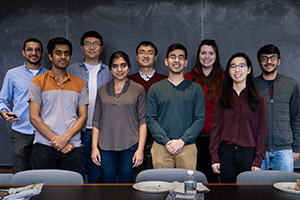
Organizing the Microsystems Annual Research Conference (MARC) is no small feat. Each January during the MIT Independent Activities Period, more than 200 students, faculty, staff, postdocs, and industry members come together at an off-campus site to explore technical achievements and research ideas at the forefront of microsystems and nanotechnology.
The secret to MARC’s success year after year? A student committee that handles every aspect of coordinating and executing the showcase event, to be held this year in late January in New Hampshire. Chaired by MIT doctoral students Mayuran Saravanapavanantham and Rachel Yang, the 2020 student leaders arrange for research talks, poster presentations, keynote lectures, and all of the logistics for transporting scores of attendees to and from the conference.
Part research symposium and part networking event, MARC strives to share new research directions, identify job opportunities, and help participants refine their technical communications skills — with a bit of skiing and snowshoeing on the side.
“MARC has many moving parts that have to be managed simultaneously,” says Saravanapavanantham, a third-year graduate student in Professor Vladimir Bulović’s Organic and Nanostructured Electronics (ONE) Lab. “In planning a large, off-campus conference, it’s really important to have a strong, dedicated committee. MARC caters to a broad audience, so we have to make sure we tie everything together to keep everyone engaged.”
Saravanapavanantham and Yang have each participated in two previous MARC conferences. Together, they have been overseeing a student committee of 13 individuals over the past six months to recreate positive elements of previous MARCs and generate new solutions to old challenges.
A strong foundation
Now in its 16th year, the conference has expanded significantly since its inception. It grew out of the semesterly VLSI Research Reviews, which began in 1984 under the Microsystems Research Center. From there, it evolved into a faculty-run research review that became known as the Microsystems Technology Laboratories (MTL) Annual Student Review. In 2005, the event was rebranded as MARC and became the student-run conference that exists today. This year, the conference is co-sponsored for the first time by MTL and MIT.nano.
The organizing committee comprises eight core committee members and five session chairs. The core committee takes on logistical responsibilities such as finding speakers, building the agenda, and working with vendors, while the session chairs focus on abstract submissions from over 90 MIT student presenters.
To keep on track, the team follows a strict timeline passed down from previous MARC co-chairs. The committee must monitor not only registration deadlines, but hotel reservations, transportation, printing of materials, and abstract reviews.
This year, the responsibilities are broken into eight categories, each chaired by a different PhD student: Navid Abedzadeh of the Department of Electrical Engineering and Computer Scence (EECS) is managing photography; Jessica Boles of EECS is managing communications training; Elaine McVay of EECS is managing social activities; Rishabh Mittal of EECS is managing registration logistics; Jatin Patil of the Department of Materials Science and Engineering is managing the website and proceedings; Morteza Sarmadi of the Department of Mechanical Engineering (MechE) is managing outreach; Jay Sircar of MechE is managing winter activities and transportation; and Miaorong Wang of EECS is managing audio/visual presentations.
Appealing to a wide audience
“One of the greatest challenges of MARC is promoting the event to encourage students, faculty, staff, and industry members to attend,” explains Yang, a second-year graduate student working on power magnetics design in Professor David Perreault’s power electronics group. “This year, we dedicated more efforts to our marketing, including adding an outreach chair to our committee.”
Their efforts paid off with 20 faculty and PIs registered to attend, a significant increase from previous years. The MARC committee also decided to make poster pitches optional in 2020 to increase students’ interest in participating.
Each year, MARC aims to host 100 poster presenters from nearly 40 research groups across seven categories. Participating students are required to go through at least one round of abstract feedback and edits, maintaining MARC’s reputation of high-quality writing. “Communications training is an essential part of the conference. We train students in abstract writing, poster design, and pitch preparation,” says Saravanapavanantham. “This helps MARC participants prepare to submit their work at future conferences.”
Abstracts are divided into eight categories that are reviewed by the 2020 session chairs. Topics include electronic and quantum devices, energy harvesting, medical devices, biotechnology, and photonics, to name a few. The five MIT students reviewing this year’s abstract submissions, all current EECS PhD students, are Mohamed Ibrahim, Kruthika Kikkeri, Jane Lai, Haozhe Wang and Qingyun Xie.
The student committee is also charged with identifying and securing keynote speakers who are experts in their field. The 2020 keynote lectures will focus on driving innovation at all scales. The speakers include Reed Sturtevant, who, as general partner of The Engine, a venture capital firm built by MIT, facilitates the launch of new technologies through startup incubation; and Mark Rosker, director of the U.S. Defense Advanced Research Projects Agency’s Microsystems Technology Office, which sets direction for micro/nanoelectronics research at a national level.
Saravanapavanantham and Yang are excited to see the committee’s planning efforts come to life at MARC 2020. The two are also looking toward the future, documenting their processes and reflecting on their visions for the future:
“We hope this conference will continue to grow as a platform to inspire ideas and to foster research collaboration between MIT and industry,” said Yang.
Share on:



Subscribe
Stay ahead of the technologies shaping the future of electronics with our latest newsletter, Advanced Electronics Packaging Digest. Get expert insights on advanced packaging, materials, and system-level innovation, delivered straight to your inbox.
Subscribe now to stay informed, competitive, and connected.
Suggested Items
Zhen Ding, Tsinghua University Launch Phase II R&D and Digital Transformation Program
04/30/2026 | Zhen DingZhen Ding Technology Holding Limited, a global leader in the PCB industry, held the launch ceremony for the Phase II (2026-2030) Industry-Academia Collaboration Program of the Zhen Ding-Tsinghua Joint Research Center at the Zhen Ding Technology Lecture Hall on the Tsinghua University campus.
AT&S Advances Glass Core Substrates for AI, HPC, and Photonics
04/22/2026 | AT&SAT&S is advancing glass core substrates from research toward industrial use in artificial intelligence, high-performance computing, high-speed communications and photonics.
IBM, UIUC Expand Discovery Accelerator for AI and Quantum Computing
04/20/2026 | PRNewswireIBM and the Grainger College of Engineering at the University of Illinois Urbana-Champaign (U. of I.) announced an expansion of the IBM-Illinois Discovery Accelerator Institute.
Long Night of Research 2026: AT&S Brings Artificial Intelligence to Life
04/15/2026 | AT&SWhen the Long Night of Research takes place throughout Austria on Friday, April 24, setting an example for the country’s innovative strength, AT&S will be there with a special highlight.
Foxconn Recognized as Top 100 Global Innovators 2026
04/14/2026 | FoxconnHon Hai Technology Group (Foxconn) has been named in Clarivate’s Top 100 Global Innovators 2026, a milestone for the ninth year running and as the accelerating role of artificial intelligence stood out in innovation activity among peers in the prestigious ranking.