














 The Marketing Minute: If Your Marketing Budget Gets Cut in Half, Then What?
 Punching Out: How Are the Big Boys in Electronics Doing?
 It’s Only Common Sense: Complexity Is the Enemy of Profit





Würth Elektronik Celebrates Internationality on Diversity Day
June 3, 2020 | Wuerth ElektronikEstimated reading time: 1 minute
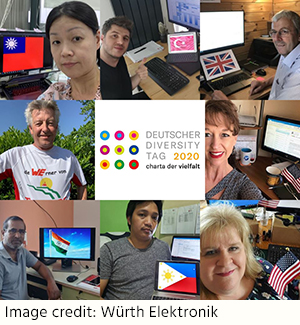
On the occasion of the Diversity Day on 26 May, Würth Elektronik celebrated its own diversity this time in terms of internationality. For five years now, the company has been part of the Diversity Charter, which this year called for online activities under the hashtag #FlagforDiversity against the background of the Corona pandemic.
For the Diversity Day, employees from all locations sent in photos of themselves in their home office or at work with the flag of their nation of origin for a large diversity collage. Würth Elektronik is a global group of companies and this is also reflected in the workforce. At the Würth Elektronik eiSos Group alone, one of the largest European manufacturers of electronic and electromechanical components, people of 40 different nationalities work in Germany. The motto "We live diversity and value diversity" in the company's job advertisements is therefore both a commitment and an expression of the reality in the company.
Share on:



Subscribe
Stay ahead of the technologies shaping the future of electronics with our latest newsletter, Advanced Electronics Packaging Digest. Get expert insights on advanced packaging, materials, and system-level innovation, delivered straight to your inbox.
Subscribe now to stay informed, competitive, and connected.
Suggested Items
Medical Device Contract Manufacturing Market to Reach $171B by 2031, Says Mordor Intelligence
05/13/2026 | PRNewswireAccording to Mordor Intelligence, the medical device contract manufacturing market size is projected to grow from USD 105.53 billion in 2026 to USD 171.03 billion by 2031, registering a CAGR of 10.14% during the forecast period (2026–2031).
Learning with Leo: Drones—Meeting Demand Without Compromise
05/06/2026 | Leo Lambert -- Column: Learning With LeoWith drones used in a wide range of applications today, particularly in modern military conflicts, domestic manufacturers are feeling pressure to produce at high volume and low cost, particularly within an NDAA supply chain ecosystem with differing needs and expectations. Two issues must be considered. First is the manufacturers’ and customers’ need for quality, reliability, and functionality of the product. Second is the manufacturing volume needed to support demand, whether for military, industrial, or commercial applications. Each segment requires verification that the product meets the customer's requirements.
AI Reshaping the Memory Market; Effects Spreading Across Industries
04/29/2026 | Dr. Shawn DuBravac, Global Electronics AssociationArtificial Intelligence is often framed as a software story focused on algorithms and models. But beneath that narrative lies a more fundamental shift rooted in hardware. AI is not just changing what technology can do; it’s changing how the physical components behind it are produced, allocated, and priced. One of the clearest examples of this shift is now emerging in the global memory market.
Horizon Sales Adds LPKF Laser and Electronics to Its Lineup
04/21/2026 | Horizon SalesHorizon Sales, a leading manufacturers’ representative and distributor to the electronics industry, is pleased to announce a new partnership with LPKF Laser and Electronics, a global leader in precision laser technology
EDIP Opens the Door: EU Funding Now Available for Defence Electronics Including PCBs and Substrates
04/21/2026 | Alison James and Chris Mitchell, Global Electronics AssociationThe European Commission has published a call for proposals under the European Defence Industry Programme (EDIP), and for European electronics manufacturers the message is clear: this is real money for real capacity, and PCBs and IC substrates are explicitly in scope. EDIP's Industrial Reinforcement Actions (IRA) dedicate €122.25 million to key electronic components, covering guidance electronics, propulsion electronics, RF and laser modules, multispectral cameras, avionics, PCBs and IC substrates, lithium-ion polymer batteries, power electronics, and critical semiconductor building blocks