














 Flexible Thinking: Designing Flex Circuits for Dynamic Reliability
 Global PCB Connections: Rigid-flex and Flexible PCBs—The Backbone of Modern Electronics
 Happy’s Tech Talk #29: Bend-to-Install Semi-flex FR-4





Trackwise Delivers Record-breaking 72m Multi-layer Flexible PCB
November 16, 2021 | Trackwise Designs PLCEstimated reading time: 1 minute
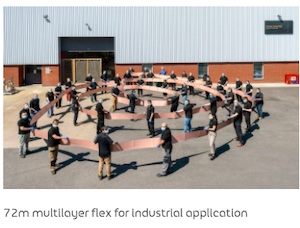
Trackwise Designs plc, the UK-based manufacturer of specialist products using printed circuit technology, has broken its own record for the world’s longest multi-layer flexible printed circuit (FPC), delivering a 72m FPC for an industrial application. Constructed using a polyimide base laminate with copper elements, and finished with an organo-metallic layer to protect against oxidization, the final circuit, and the exceptional circuit consistency, was made possible thanks to their patented Improved Harness technology.
The customer also recognized Trackwise’s ability to deliver a constant copper thickness across and along the manufactured part, thanks to a reel-to-reel copper plating line, achieving within +/- 5um across and along the entire 72m long part. This allowed for defined and tightly controlled layer to layer resistance with as thin as possible thickness for the flex in the end product.
New Record
“We are delighted to have smashed our previous 2020 record of 52m, which itself beat our 2019 record of 25m,” said Philip Johnston, Trackwise CEO. “Many applications are emerging for very long FPCs as customers become aware of the advantages offered by the technology. As well as the industrial sector, we are also winning business in the aerospace and automotive industries where our FPCs can help to increase battery life and EV range, for example, by reducing weight. Another key market is medical where users look to replace existing microwires with a cheaper, more reliable, and flexible solutions.
The versatility and cost effectiveness of the roll-to-roll, length-unlimited manufacturing capability means that we are delivering improved connectivity solutions for new and innovative product designs all the time, even where the client does not need a product as extreme as 72m in length!”
Share on:


Testimonial
"We’re proud to call I-Connect007 a trusted partner. Their innovative approach and industry insight made our podcast collaboration a success by connecting us with the right audience and delivering real results."
Julia McCaffrey - NCAB GroupSuggested Items
TPCA Launches AI-Powered PCB GPT Knowledge Platform
05/15/2026 | TPCAThe Taiwan Printed Circuit Association (TPCA) has launched the "PCB GPT Industry Knowledge Platform," which uses generative AI to connect PCB professional knowledge services and help the industry improve the efficiency of cross-border and professional talent training.
I-Connect007 Editor’s Choice: Five Must-Reads for the Week
05/15/2026 | Nolan Johnson, I-Connect007When you work in the news business, even in trade media, you can never really get that far away from it. We never want to miss something important. Chances are, even the books we take on our “vacations” end up having to do with the business. For example, my colleague Michelle Te recommended “Creativity, Inc., by Ed Catmull, a business skills study wrapped up in stories about Pixar, which I brought with me on a trip through the stunning U.S. Mountain West. Now, I’m back, and here are my recommendations for the week.
STARTEAM GLOBAL Achieves A Score in CDP’s Supplier Engagement Assessment
05/14/2026 | STARTEAM GLOBALSTARTEAM GLOBAL has achieved an A score in CDP’s Supplier Engagement Assessment (SEA).
Rethinking Stackup, Materials, and Tolerances in Modern Designs
05/14/2026 | Kristin Moyer, Global Electronics AssociationThe simple rectangular rigid PCB is becoming increasingly infrequent. This reality necessitates designing with concepts well outside traditional rigid PCB methodologies. For example, the designer of wearable electronics may need to implement conductive fibers integrated into the textile material. Heads-up displays, like those in VR/AR headsets and glasses, require transparent circuitry etched into the display glass. The process of designing without a rule book usually starts with something other than the traditional board design process.
Separating Fact from Fear on the FCC ‘China Lab Ban’
05/14/2026 | Jan Pedersen, NCAB GroupRecent news headlines have suggested that the U.S. Federal Communications Commission (FCC) has “banned all testing laboratories in China and Hong Kong.” Understandably, this has created concerns around PCB testing, material approvals, UL listings, and the continued use of established test laboratories in Asia. The good news is that for most PCB, PCB material, and PCBA testing, nothing has changed. Let’s separate fact from fear.