













 Dan’s Biz Bookshelf: ‘Abundance: How We Build a Better Future’
 Trouble in Your Tank: In Complex Systems, Design Rules Aren’t Optional
 It’s Only Common Sense: The Phone Is Still Your Competitive Advantage





Researchers Bring More Reliable Electricity to Puerto Rican Microgrids
September 13, 2022 | ORNLEstimated reading time: 4 minutes
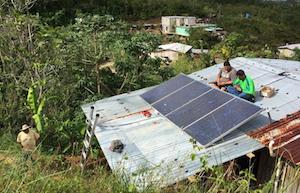
When Hurricane Maria battered Puerto Rico in 2017, winds snapped trees and destroyed homes, while heavy rains transformed streets into rivers. But after the storm passed, the human toll continued to grow as residents struggled without electricity for months. Five years later, power outages remain long and frequent.
To provide more affordable, reliable and sustainable electricity to underserved communities like these, scientists from the Department of Energy’s Oak Ridge National Laboratory are partnering with local organizations, nonprofits and universities to build resilience into independent microgrids powered by renewable energy. ORNL is developing a technology that will manage groups of small microgrids as a cluster, enhancing their reliability even when damaged.
Microgrids are small networks that generally have their own energy supply from nearby renewable sources like wind and solar. If battery storage is added, microgrids can be isolated and function independently in “island mode” when the broader utility network fails.
ORNL engineers Ben Ollis and Max Ferrari are leading a team to develop a microgrid orchestrator to deploy in the Puerto Rican town of Adjuntas. A community microgrid project is already being installed there, through a partnership between local nonprofit Casa Pueblo and the Honnold Foundation.
Honnold, which funds solar projects to reduce global energy poverty, is investing $1.7 million to create two microgrids with solar and battery storage, said Honnold project coordinator Cynthia Arellano. The solar arrays were installed last year and will be hooked to the remaining infrastructure being added this year.
That’s where ORNL steps in: Creating a novel orchestrator tool to manage a cluster of microgrids so they directly support and communicate with each other, making them more resilient during long power outages. For example, if one microgrid loses part of its solar generation, the adjacent microgrid could export power to its neighbor, minimizing the impact of the damage.
“I don’t know of a microgrid controller anywhere that can communicate and coordinate with another controller,” Ollis said. “We’re designing an architecture for multi-microgrid controls, so any number of microgrids can operate independently but share information to an orchestrator that will predict when switching, routing and connecting should happen.”
Ferrari said initial simulations indicate the microgrids could keep each other running at least a week. But with ideal conditions, they could potentially keep operating indefinitely.
That isn’t just a matter of convenience. “A lot of people died after the hurricane, and many of the deaths were related to power failures,” said Arturo Massol-Deyá, executive director of Casa Pueblo, which promotes fair and sustainable development around Adjuntas. This longtime community organization installed a solar array at its building in 1999. After Hurricane Maria, Casa Pueblo was able to share the electricity it generated with residents relying on home medical equipment such as respirators.
“We noticed how many people got sick who were pre-diabetic, or had high blood pressure, or were exposed to unhealthy living conditions and food – preventable conditions,” said Massol-Deyá. “Energy security being interrupted is about quality of life, and there were long-term consequences in the community.” Grassroots support for solar power built steadily as a result.
Community-wide benefits
The Adjuntas microgrids include solar installations on the roofs of 13 businesses, whose owners agree to provide critical services like medicine, refrigeration and cell phone charging to residents during major power outages. In return, the businesses save money on electricity and avoid the use of expensive diesel generators during natural disasters, Ferrari said.
“ORNL deploying this kind of controller system is going to be a really powerful tool for the community,” Arellano said. It’s unusual for so many businesses and owners to be linked by a microgrid, she added, and the infrastructure will support adding even more.
On a recent trip to Adjuntas, ORNL researchers met with local business owners to better understand their electricity use patterns. For example, when Ferrari visited the bakery, he learned what times refrigerators must run for the dough to rise properly. He and Ollis sought to identify the most critical electricity loads so they can design a system that focuses scarce power where it’s most needed.
“Hopefully it will help not only to manage the microgrids, but also to protect the critical components like the energy storage unit,” said Massol-Deyá, who is also a professor at University of Puerto Rico Mayaguez, or UPRM.
The income produced by the community-owned microgrids will fund their maintenance and expansion, as well as installation of independent solar systems for the most disadvantaged Adjuntas residents, he said.
A sense of urgency
Fabio Andrade is a UPRM engineering professor and a visiting scientist at ORNL collaborating on the Adjuntas project. His students model strategies, tools and algorithms for sharing solar power among microgrid users. UPRM colleague Gerson Beauchamp guides students through analyzing the solar equipment and predicting how much energy it will produce. At current electricity prices, the businesses can collectively expect to save as much as $78,000 a year by buying solar energy from the microgrids, Beauchamp said.
Ferrari is incorporating information from UPRM colleagues into his simulations, which are being tested live with actual microgrid hardware at DOE’s Grid Research Integration and Deployment Center, or GRID-C, at ORNL. The next step is running the configuration in the facility’s brand-new networked testbed for microgrids. In another year, the orchestrator will be deployed in Adjuntas.
While the ORNL-derived technology could be a literal lifesaver in Puerto Rico, it also holds broader potential for enabling microgrids to play a key role in the global grid of the future. Intelligent microgrids that incorporate renewable energy are poised to advance grid flexibility and resiliency while supporting vital decarbonization efforts.
“The orchestrator includes a framework of algorithms that can be expanded and deployed to many microgrids at any site,” Ollis said. “They could provide more reliable electricity to many rural communities at the grid edge. I want to see a future where we have hundreds of microgrids working together to protect critical infrastructure at local, regional and national levels.”
ORNL’s work on the Adjuntas project is funded through DOE’s Solar Energy Technologies Office. Much of the microgrid orchestrator design, configuration and testing is occurring in the microgrid testbed called COMMANDER (Coordination of Multi-Microgrids and Networked Distributed Energy Resources), which is part of the GRID-C facility funded by DOE’s Office of Electricity.
Other members of the ORNL team working on the Adjuntas microgrids project are Guodong Liu, Aditya Sundararajan, Mohammed M. Olama and Yang Chen. Additional academic partners include the University of Central Florida and the University of Tennessee.
UT-Battelle manages Oak Ridge National Laboratory for the U.S. Department of Energy’s Office of Science. The single largest supporter of basic research in the physical sciences in the United States, the Office of Science is working to address some of the most pressing challenges of our time.
Share on:



Subscribe
Stay ahead of the technologies shaping the future of electronics with our latest newsletter, Advanced Electronics Packaging Digest. Get expert insights on advanced packaging, materials, and system-level innovation, delivered straight to your inbox.
Subscribe now to stay informed, competitive, and connected.
Suggested Items
ASC’s John Johnson Bullish on the U.S. and High-tech PCBs
04/28/2026 | Marcy LaRont, I-Connect007It was a good couple of days at the SMTA UHDI Symposium in Avondale, Arizona, in early April, where John Johnson, head of technology at American Standard Circuits (ASC) and resident PCB expert on UHDI in the real-world of manufacturing, was a presenter. As the symposium ended, I visited with John, who reflected on what he considered most important and what had made the greatest impression on him.
Cleaning Is Critical
04/28/2026 | Nolan Johnson, SMT007 MagazineMike Bixenman, president of Magnalytix, and his colleagues Vladimir Sitko, founder of PBT Works, and Adam Klett, PhD, director of science at KYZEN, discussed how cleaning can affect reliability, in a Professional Development Course at APEX EXPO 2026. We spoke to Mike after the session to better understand the context for the current activity in cleaning technology.
A Mic, a Tiny Cam, and the Show Floor: The Story Behind 'Take the Mic!'
04/23/2026 | I-Connect007 Editorial TeamI-Connect007’s Take the Mic! program at APEX EXPO 2026 in Anaheim is proving to be a must-watch feature for this year’s event coverage, as we invited company representatives to participate in a sponsored conversation about their businesses and products in a whole new way: in front of a camera at their booths. While our managing editors and guest editors were conducting slightly longer Real Time with… APEX EXPO interviews in our booth, three staff members and guests acted as roaming reporters, conducting short, prearranged interviews with several companies exhibiting on the show floor.
PHOTO GALLERY: A Walk on the Lighter Side
04/23/2026 | I-Connect007APEX EXPO isn’t all business! To wrap up our last photo gallery, we’re sharing some of our favorites from the show—a walk on the lighter side. We’re highlighting those in-between moments: quick selfies, familiar faces reconnecting, robot dogs, booth-side laughs, and the kind of candid snapshots you only get when people are genuinely enjoying themselves. At the end of the day, it’s not just about what we do, it’s about the people we do it with.
Koh Young Highlighting its Smart AI Solutions at the SMTA Monterrey Expo and Tech Forum
04/15/2026 | Koh YoungKoh Young, the industry leader in True 3D measurement-based inspection solutions, will exhibit at the upcoming SMTA Monterrey Expo & Tech Forum on Thursday, April 23, 2026, at Cintermex, located at Av. Fundidora 501, Colonia Obrera, Monterrey, Nuevo León, Mexico.