













 Dan’s Biz Bookshelf: ‘Abundance: How We Build a Better Future’
 Trouble in Your Tank: In Complex Systems, Design Rules Aren’t Optional
 It’s Only Common Sense: The Phone Is Still Your Competitive Advantage





A Printable, Flexible, Lightweight Temperature Sensor
November 16, 2015 | University of TokyoEstimated reading time: 2 minutes
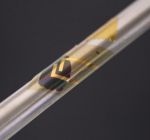
A University of Tokyo research group has developed a flexible, lightweight sensor that responds rapidly to tiny thermal changes in the range of human body temperature. This sensor is expected to find healthcare and welfare applications in devices for monitoring body temperature, for example of newborn infants or of patients in intensive care settings.
Flexible and wearable devices are increasingly being developed for healthcare and other applications where temperature and other sensors are integrated to provide feedback on patient health and wellbeing. Body temperature is a fundamental measurement and many low-cost flexible temperature sensors have been demonstrated, but devices developed to date require external circuitry to amplify the signal to allow accurate temperature measurement.
In their latest research, Professor Takao Someya and Dr. Tomoyuki Yokota's research group at the Graduate School of Engineering have developed a new printable, flexible, lightweight temperature sensor that shows a very high change in electrical resistance of up to 100,000 times over a range of just five degrees centigrade, allowing accurate temperature measurement without additional complicated display circuitry.
The key to the new sensor is the ability to precisely control the target temperature of the sensors. The sensor is composed of graphite and a semicrystalline acrylate polymer formed of two monomers, molecules that bond together to form a polymer chain. The target temperature range at which the sensor is most precise can be selected simply by altering the proportions of the two monomers. The research group achieved target temperatures between 25 and 50 degrees centigrade, a range which includes average human body temperature, and simultaneously realizing response times of less than 100 milliseconds and a temperature sensitivity of 0.02 degrees centigrade. The device was also stable even under physiological conditions, providing repeated readings up to 1,800 times.
The research group tested their new sensor by printing a flexible thermal monitoring device which was placed directly on the lung of a rat to measure lung temperature. The device successfully measured cyclic changes in lung temperature of just 0.1 degrees centigrade as the animal breathed, demonstrating its utility as a sensor for monitoring body vital signs in physiological (internal) settings.
"By printing an array of these sensors it is possible to measure surface temperature over a large area," says Professor Someya. He continues, "This sensor array can be attached to biological tissue such as the skin for precise monitoring in medical applications. Because the huge response of the sensor to temperature change allows us to simplify the circuitry, we could print our sensors onto adhesive plasters that could then monitor body temperature. For example, a plaster applied directly to a wound or after surgery could provide warning of infection by detecting local changes in temperature due to inflammation."
Other possible applications include wearable electronic apparel, where the sensor could be applied beneath fabric to measure temperature during sporting and other activities.
Share on:



Subscribe
Stay ahead of the technologies shaping the future of electronics with our latest newsletter, Advanced Electronics Packaging Digest. Get expert insights on advanced packaging, materials, and system-level innovation, delivered straight to your inbox.
Subscribe now to stay informed, competitive, and connected.
Suggested Items
Indium to Showcase High-Performance AI Application Solutions at SEMICON SEA 2026
05/01/2026 | Indium CorporationAs a leading provider of advanced materials solutions for today’s demanding AI applications, Indium Corporation® will feature its high-reliability product portfolio at SEMICON SEA 2026, May 5-7, in Kuala Lumpur, Malaysia.
Unitemp Launches ESPEC Deep Capacity HAST Chamber in UK for Large PCB Testing
03/24/2026 | UnitempA new deep‑capacity Highly Accelerated Stress Test (HAST) chamber capable of accommodating large multilayer PCBs and high specimen volumes is now available in the UK, as Unitemp introduces ESPEC’s latest model, the EHS‑222M‑L.
SEEQC Unveils Integrated Qubit Control Quantum Chip
03/19/2026 | BUSINESS WIRESEEQC announced a significant breakthrough in the development of scalable, chip-based quantum computers, with results published in a peer-reviewed study in Nature Electronics.
Indium Corporation Experts to Present on Array of Solder and Thermal Management Solutions at APEX EXPO 2026
03/12/2026 | Indium CorporationAs a leading materials provider for the advanced electronic packaging market, Indium Corporation® experts will share their technical insight and knowledge on a variety of industry-related topics at APEX EXPO 2026, March 17-19, in Anaheim, California.
T-type Thermocouples in Foil Heater Technology
03/12/2026 | Zack Schaner, Flexible Circuit TechnologiesThis article examines the use of T-type thermocouples implemented with flexible printed circuit and etched foil heater technology, focusing on their design, fabrication, and integration into advanced thermal management systems. I’ll give particular attention to how their low-profile construction, accuracy at low temperatures, and mechanical robustness make them well-suited for critical devices operating in demanding environments