














 It’s Only Common Sense: When the Cheapest Board Becomes the Most Expensive
 The Chemical Connection: Employee and Operator Empowerment in the Age of AI
 The Big Picture: Not One, But Three Grey Rhinos





Closeup of liquid-based lenses that can automatically adjust the focus on what a person is seeing.
The lenses are placed in special eyeglass frames also invented by Mastrangelo, Hasan and other members of the research group with electronics and a battery to control and power the actuators. In the bridge of the glasses is a distance meter that measures the distance from the glasses to an object via pulses of infrared light. When the wearer looks at an object, the meter instantly measures the distance and tells the actuators how to curve the lenses. If the user then sees another object that’s closer, the distance meter readjusts and tells the actuators to reshape the lens for farsightedness. Hasan says the lenses can change focus from one object to another in 14 milliseconds. A rechargeable battery in the frames could last more than 24 hours per charge, Mastrangelo says.
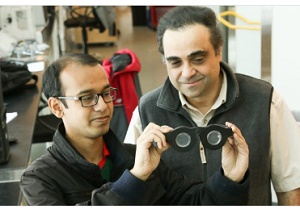
Early prototype of “smart glasses.” The lenses are placed in battery-powered frames that can automatically adjust the focal length of the lenses based on what the wearer is looking at. Researchers expect to have smaller, lighter frames with the technology in as early as three years.
Before putting them on for the first time, all users have to do is input their eyeglasses prescription into an accompanying smartphone app, which then calibrates the lenses automatically via a Bluetooth connection. Users only needs to do that once except for when their prescription changes over time, and theoretically, eyeglass wearers will never have to buy another pair again since these glasses would constantly adjust to their eyesight.
Currently, the team has constructed a bulky working prototype that they put on display at last month’s Consumer Electronics Show in Las Vegas, but expect to constantly improve the design to make them smaller and lighter. Mastrangelo said a lighter, more attractive pair could hit the marketplace in as early as three years and that a startup company, Sharpeyes LLC, has been created to commercialize the glasses.


