















 Flexible Thinking: ‘Let There Be Light’–Emitting Diodes!
 Target Condition: Flex and Rigid-flex Solutions in A&D Display Electronics
 Global PCB Connections: Rigid-flex and Flexible PCBs—The Backbone of Modern Electronics





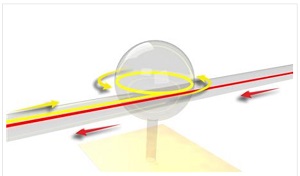
Researchers from the University of Illinois at Urbana-Champaign have demonstrated a new level of optical isolation necessary to advance on-chip optical signal processing. The technique involving light-sound interaction can be implemented in nearly any photonic foundry process and can significantly impact optical computing and communication systems.
“Low-loss optical isolators are critical components for signal routing and protection, but their chip-scale integration into photonic circuits is not yet practical. Isolators act as optical diodes by allowing light to pass through one way while blocking it in the opposite direction,” explained Gaurav Bahl, an assistant professor of mechanical science and engineering at Illinois. “In this study, we demonstrated that complete optical isolation can be obtained within any dielectric waveguide using a very simple approach, and without the use of magnets or magnetic materials.”
The key characteristics of ideal optical isolators are that they should permit light with zero loss one way, while absorbing light perfectly in the opposite direction, i.e. the condition of ‘complete’ isolation. Ideal isolators should also have a wide bandwidth and must be linear, i.e. the optical signal wavelength does not change through the device and the properties are independent of signal strength. The best method, to date, for achieving isolation with these characteristics has been through the magneto-optic Faraday rotation effect occurring in special gyrotropic materials, e.g. garnet crystals. Unfortunately, this technique has proven challenging to implement in chip-scale photonics due to fabrication complexity, difficulty in locally confining magnetic fields, and significant material losses. In light of this challenge, several non-magnetic alternatives for breaking reciprocity have been explored both theoretically and experimentally.
In a previous study, Bahl’s research team experimentally demonstrated, for the first time, the phenomenon of Brillouin Scattering Induced Transparency (BSIT), in which light-sound coupling can be used to slow down, speed up, and block light in an optical waveguide.
“The most significant aspect of that discovery is the observation that BSIT is a non-reciprocal phenomenon—the transparency is only generated one way. In the other direction, the system still absorbs light,” Bahl said. “This non-reciprocal behavior can be exploited to build isolators and circulators that are indispensable tools in an optical designer’s toolkit.”
“In this work, we experimentally demonstrate complete linear optical isolation in a waveguide-resonator system composed entirely of silica glass, by pushing the BSIT interaction into the strong coupling regime, and probing optical transmission through the waveguide in the forward and backward directions simultaneously,” stated JunHwan Kim, a graduate student and first author of the paper, “Complete linear optical isolation at the microscale with ultralow loss,” appearing in Scientific Reports.
“Experimentally, we have demonstrated a linear isolator capable of generating a record-breaking 78.6 dB of contrast for only 1 dB of forward insertion loss within the isolation band,” J. Kim added. “This means that light propagating backwards is nearly 100-million times more strongly suppressed than light in the forward direction. We also demonstrate the dynamic optical reconfigurability of the isolation direction.”
“Currently the effect has been demonstrated in a narrow bandwidth. In the future, wider bandwidth isolation may also be approached if the waveguide and resonator are integrated on-chip, since remaining mechanical issues can be eliminated and the interacting modes can be designed precisely, “ Bahl said. “Achieving complete linear optical isolation through opto-mechanical interactions like BSIT that occur in all media, irrespective of crystallinity or amorphicity, material band structure, magnetic bias, or presence of gain, ensures that the technique could be implemented with nearly any optical material in nearly any commercial photonics foundry.”
Since it avoids magnetic fields or radiofrequency driving fields, this approach is particularly attractive for chip-scale cold atom microsystems technologies, for both isolation and shuttering of optical signals, and on-chip laser protection without loss.
In addition to J. Kim and Bahl, graduate student Seunghwi Kim is a co-first author of the study. Funding for this research was provided through the DARPA Cold Atom Microsystems program and the Air Force Office for Scientific Research Young Investigator program.


