















 American Made Advocacy: Five Years of Educating, Advocating, and Influencing Legislation and Policy
 Defense Speak Interpreted: Understanding What the Department of Defense Is, and Isn’t
 The Right Approach: The End of an Era—DoD Proposes MIL-PRF-31032 Cancellation





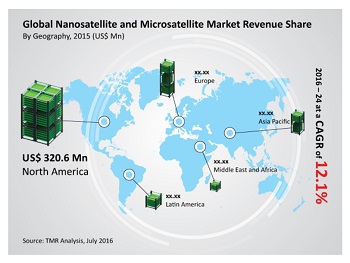
The global nanosatellite and microsatellite market is led by companies such as Lockheed Martin Corporation, Raytheon, RUAG Group, Planet Labs Inc., Clyde Space Inc., Sierra Nevada Corporation, and Spacequest Ltd. The high commercial potential of the nanosatellite and microsatellite market has led to many new players entering the market in recent years, with many private companies posting solid, consistent progress. Government investment in the global nanosatellite and microsatellite market has also been on the rise, leading to a promising competitive landscape.
According to Transparency Market Research (TMR), the global nanosatellite and microsatellite market is expected to exhibit a robust 12.1% CAGR from 2016 to 2024, rising in valuation to $2.2 billion by the end of 2024.
Asia Pacific to Emerge as Major Player in Nanosatellite and Microsatellite Market
The global nanosatellite and microsatellite market is currently dominated by North America. The strong establishment of the space program in the country is a major reason for the dominance of the region in the global market, as even private companies in the region, such as SpaceX, are coming up with robust results in the global nanosatellite and microsatellite market.
However, Asia Pacific is likely to become a key power in the global nanosatellite and microsatellite market in the coming years on the back of the promising performance of space programs such as the Indian Space Research Organization (ISRO). Having earned its name due to several commendable achievements in recent years, ISRO has emerged as a pioneer in the global nanosatellite and microsatellite market. Other space agencies in Asia Pacific, such as those in China and Japan, are also likely to play a major part in the development of the nanosatellite and microsatellite market in the region.
Rising Need for Satellite-based Communication and Imaging to Drive Market
The global nanosatellite and microsatellite market has experienced steady growth in the last few decades as the utility of satellites in various communication enterprises has come to be fully acknowledged. Instead of using larger conventional satellites, many enterprises are now starting to rely on the efficiency of the relatively smaller nanosatellites and microsatellites. The rising demand for satellite-based communication channels is likely to keep this a key driver for the global nanosatellites and microsatellites market. Apart from communication, the application of nanosatellites and microsatellites in navigation and mapping is also set to increase in the coming years, leading to steady demand from the global nanosatellites and microsatellites market.
The education and defense sectors are becoming important for the global nanosatellite and microsatellite market. The increasing demand for remote learning through the Internet and the steady private and government backing being given to it is likely to keep the education sector a leading application segment of the global nanosatellite and microsatellite market. The increasing focus on smart army and military modernization initiatives is the key factor driving the importance of the defense sector to the nanosatellite and microsatellite market.
The rising demand for broadband Internet services in developing countries is a key driver for the global nanosatellite and microsatellite market. Due to the rising disposable income of consumers in dynamic economies, their consumption of online media has risen steadily in the recent past and has become a significant factor for the nanosatellite and microsatellite market.


