
Cheaper and Easier Way Found to Make Plastic Semiconductors
April 27, 2018 | University of WaterlooEstimated reading time: 2 minutes
Cheap, flexible and sustainable plastic semiconductors will soon be a reality thanks to a breakthrough by chemists at the University of Waterloo.
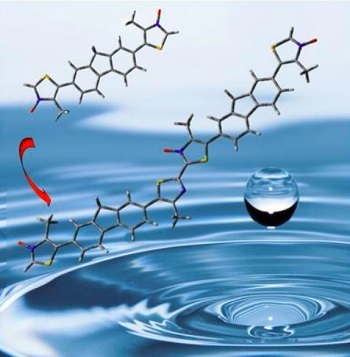
Professor Derek Schipper and his team at Waterloo have developed a way to make conjugated polymers, plastics that conduct electricity like metals, using a simple dehydration reaction the only byproduct of which is water.
“Nature has been using this reaction for billions of years and industry more than a hundred,” said Schipper, a professor of Chemistry and a Canada Research Chair in Organic Material Synthesis. “It’s one of the cheapest and most environmentally friendly reactions for producing plastics.”
Schipper and his team have successfully applied this reaction to create poly(hetero)arenes, one of the most studied classes of conjugated polymers which have been used to make lightweight, low- cost electronics such as solar cells, LED displays, and chemical and biochemical sensors.
Dehydration is a common method to make polymers, a chain of repeating molecules or monomers that link up like a train. Nature uses the dehydration reaction to make complex sugars from glucose, as well as proteins and other biological building blocks such as cellulose. Plastics manufacturers use it to make everything from nylon to polyester, cheaply and in mind-boggling bulk.
“Synthesis has been a long-standing problem in this field,” said Schipper. “A dehydration method such as ours will streamline the entire process from discovery of new derivatives to commercial product development. Better still, the reaction proceeds relatively fast and at room temperature.”
Conjugated polymers were first discovered by Alan Heeger, Alan McDonald, and Hideki Shirakawa in the late 1970s, eventually earning them the Nobel Prize in Chemistry in 2000.
Researchers and engineers quickly discovered several new polymer classes with plenty of commercial applications, including a semiconducting version of the material; but progress has stalled in reaching markets in large part because conjugated polymers are so hard to make. The multi-step reactions often involve expensive catalysts and produce environmentally harmful waste products.
Schipper and his team are continuing to perfect the technique while also working on developing dehydration synthesis methods for other classes of conjugated polymers. The results of their research so far appeared recently in the journal Chemistry – A European Journal.
About the University of Waterloo
University of Waterloo is Canada’s top innovation university. With more than 36,000 students we are home to the world's largest co-operative education system of its kind. Our unmatched entrepreneurial culture, combined with an intensive focus on research, powers one of the top innovation hubs in the world.
Subscribe
Stay ahead of the technologies shaping the future of electronics with our latest newsletter, Advanced Electronics Packaging Digest. Get expert insights on advanced packaging, materials, and system-level innovation, delivered straight to your inbox.
Subscribe now to stay informed, competitive, and connected.
Suggested Items
When Quality Is Personal: The Human Stakes Behind Electronics Reliability
05/06/2026 | Kelly DackIn electronics manufacturing, quality is often discussed in terms of specifications, standards, and process controls, but as industry veteran Doug Pauls reminds us, the stakes are far more human. In this conversation, Doug, a recipient of the Global Electronics Association’s Hall of Fame Award, draws on more than four decades of experience to illuminate the real-world consequences of reliability, where even a single defect can carry profound implications. He brings into sharp focus why quality isn’t just a metric, but a responsibility shared by everyone on the manufacturing floor.
PCBAA, AAM Take on the Fight to Rebuild U.S. Manufacturing in New Documentary
05/05/2026 | Marcy LaRont, I-Connect007Throughout most of the 20th century, manufacturing was central to the American Dream of providing stable jobs and pathways to upward mobility. Today, more than 80% of global electronics manufacturing capacity resides in China and greater Asia, raising serious concerns about supply chain resilience and national security.
India’s Vasantha Advanced Systems: EMS Success for 30 Years
04/22/2026 | Marcy LaRont, I-Connect007Based in one of India’s premier manufacturing regions, Vasantha Advanced Systems is an EMS provider that has built a reputation for quality, reliability, and long-term customer partnerships, earning repeated recognition from the Indian government through its National MSME Awards. Now, with a full spectrum of capabilities spanning PCB assembly, box build, and wire harness, and a workforce of more than 500, Vasantha is expanding its presence into the U.S. market. At APEX EXPO, I met Dr. Chidambaranathan and learned how this rising global player is positioning itself to meet the evolving needs of North American customers.
April Issue of I-Connect007 Magazine: Beyond the Rulebook
04/14/2026 | I-Connect007 Editorial TeamIn this month’s I-Connect007 Magazine, we asked PCB designers, fabricators, and suppliers what it really means to operate without a rulebook. Their perspectives vary, especially between seasoned designers and experienced fabricators, but a common thread emerges: progress depends on pushing boundaries and finding a way forward, even when the path isn’t clear. In many ways, this mindset has always been part of what we do, whether we’ve called it that or not.
Defense Speak Interpreted: Hypersonics Report Back After Six Years of Silence
04/07/2026 | Dennis Fritz -- Column: Defense Speak InterpretedIt’s been six years since my Defense Speaks column about hypersonic weapons. Back then, these weapons were the most sought-after technology as there was little defense for them. They were the cornerstone of the “strike any location on earth within one hour” scenario. Of course, the war in Ukraine, and now the action in Iran, have grabbed the weapons headlines, but hypersonics still play a role and development continues. Here is the update.